SAT Mastery Series: Math Deep Dive – Circles & Geometry (Module 15)
![[HERO] SAT Mastery Series: Math Deep Dive – Circles & Geometry (Module 15)](https://cdn.marblism.com/jRKLRg7E4PV.webp)
Let's be real, circle questions on the SAT can feel like they're designed to trip you up. You see the equation x² + y² + 8x - 6y + 16 = 0 and your brain immediately goes, "Wait, where's the center? What's the radius? Is this even a circle?"
Here's the truth: circle problems are some of the most predictable questions on the SAT Math section. Once you know the patterns, you'll start seeing these as free points instead of time-drains. This module is your toolkit for mastering arcs, sectors, and that standard equation that looks scarier than it actually is.
We're going deep today. 70% of this module is practice with step-by-step explanations, because reading about circles won't cut it. You need to do the work.
The Circle "Cheat Sheet" You Actually Need
Before we dive into problems, let's nail down the formulas you'll use again and again.
The Standard Equation of a Circle:
(x - h)² + (y - k)² = r²
- (h, k) = center of the circle
- r = radius
That's it. If you see this form, you can instantly identify the center and radius. The problem? The SAT loves giving you circles in expanded form (like the equation above). That's where Completing the Square becomes your best friend.
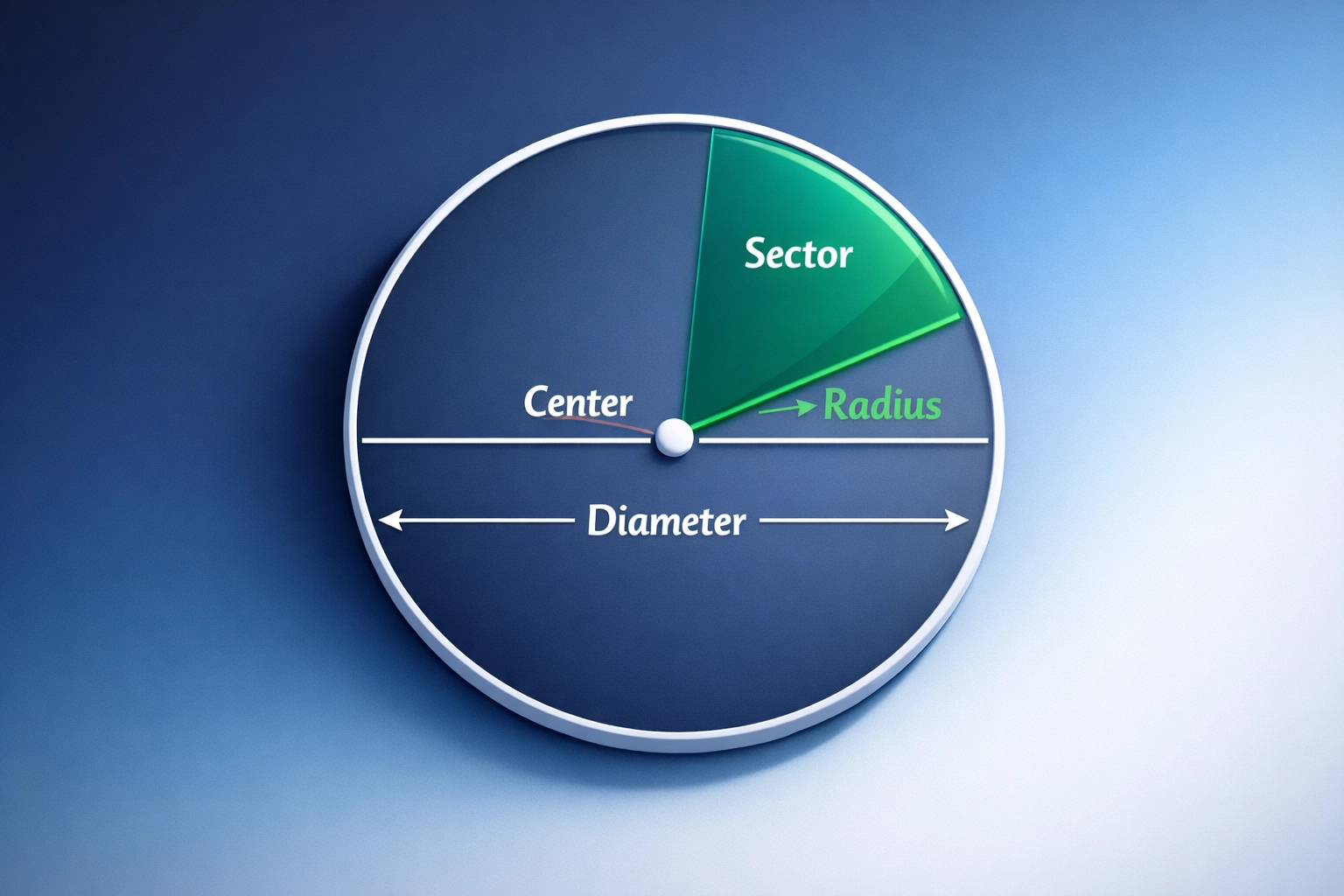
Arc Length and Sector Area:
These are just fractions of the whole circle.
- Arc Length = (θ/360) × 2πr (just the curved edge of a slice)
- Sector Area = (θ/360) × πr² (the entire "pizza slice")
The key is recognizing the proportionality shortcut: If a central angle is 60°, that's 60/360 = 1/6 of the circle. So the arc is 1/6 of the circumference, and the sector is 1/6 of the area. No need to memorize separate formulas.
Strategy #1: Completing the Square for Circles
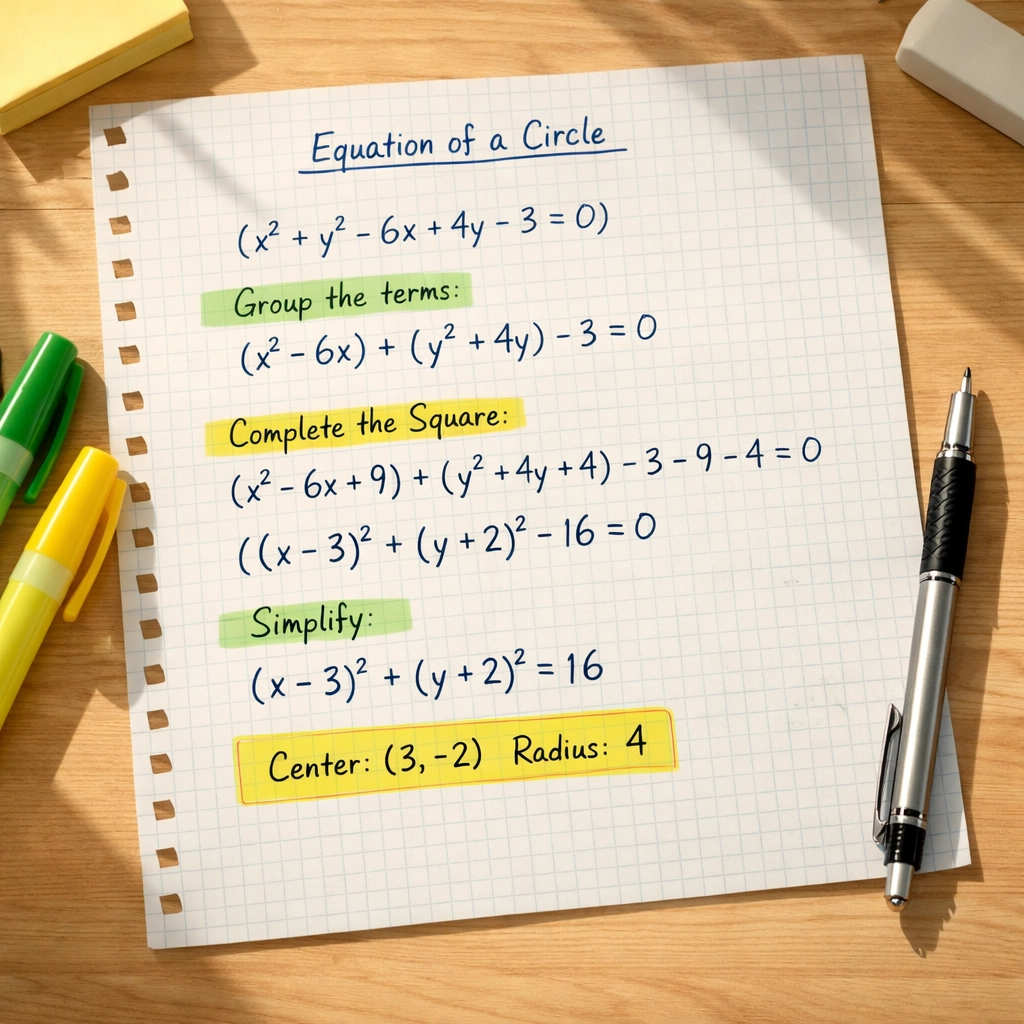
When you see an equation like x² + y² + 8x - 6y + 16 = 0, your job is to rewrite it in standard form. Here's the process:
Step 1: Group the x terms and y terms together.
(x² + 8x) + (y² - 6y) = -16
Step 2: Complete the square for both groups.
For x² + 8x: Take half of 8 → 4, then square it → 16. Add 16 inside the parentheses.
For y² - 6y: Take half of -6 → -3, then square it → 9. Add 9 inside the parentheses.
(x² + 8x + 16) + (y² - 6y + 9) = -16 + 16 + 9
Step 3: Factor and simplify.
(x + 4)² + (y - 3)² = 9
Now you can read it: Center at (-4, 3), radius = 3 (since r² = 9).
The most common mistake? Sign errors on the center. If you see (x + 4)², the center's x-coordinate is -4, not +4. Always flip the sign.
Practice Problems with Tutor Scripts
Alright, let's get into it. These are the types of questions you'll see on test day. Work through them first, then check the explanations.
Problem 1: Finding the Center and Radius
What is the center and radius of the circle given by the equation x² + y² - 10x + 4y + 13 = 0?
Tutor Script:
"Okay, first thing, this isn't in standard form yet. We need to complete the square for both x and y.
Group the terms: (x² - 10x) + (y² + 4y) = -13
For x² - 10x: Half of -10 is -5, squared is 25. Add it.
For y² + 4y: Half of 4 is 2, squared is 4. Add it.
(x² - 10x + 25) + (y² + 4y + 4) = -13 + 25 + 4
Factor: (x - 5)² + (y + 2)² = 16
Center: (5, -2) (remember to flip the signs!)
Radius: 4 (since √16 = 4)
Done. The trick is staying organized with your signs."
Problem 2: Arc Length
A circle has a radius of 12. If a central angle measures 150°, what is the length of the arc it intercepts?
Tutor Script:
"Arc length questions are all about proportions. The central angle is 150° out of 360° total, so the arc is 150/360 of the full circumference.
Simplify: 150/360 = 5/12
Full circumference = 2πr = 2π(12) = 24π
Arc length = (5/12) × 24π = 10π
That's it. No need to overthink it, just set up the proportion and multiply."
Problem 3: Sector Area
The same circle from Problem 2 (radius 12, central angle 150°). What's the area of the sector?
Tutor Script:
"Same proportion, different formula. The sector is still 5/12 of the circle, but now we're looking at area.
Full area = πr² = π(12²) = 144π
Sector area = (5/12) × 144π = 60π
See the pattern? Once you find the fraction (5/12), you're just applying it to either circumference or area."
Problem 4: Coordinate Geometry Mix
A circle in the xy-plane has the equation (x - 3)² + (y + 1)² = 25. Does the point (6, 3) lie on the circle?
Tutor Script:
"To check if a point is on the circle, plug it into the equation and see if it works.
Substitute x = 6, y = 3:
(6 - 3)² + (3 + 1)² = 25
3² + 4² = 9 + 16 = 25
Yes! It equals 25, so the point (6, 3) is on the circle. If you got anything other than 25, the point wouldn't be on it."

Problem 5: Completing the Square (Harder)
Rewrite x² + y² + 6x - 8y = 0 in standard form and identify the radius.
Tutor Script:
"Alright, this one's got a zero on the right side, which can mess people up. Let's complete the square.
Group: (x² + 6x) + (y² - 8y) = 0
For x² + 6x: Half of 6 is 3, squared is 9.
For y² - 8y: Half of -8 is -4, squared is 16.
(x² + 6x + 9) + (y² - 8y + 16) = 0 + 9 + 16
Factor: (x + 3)² + (y - 4)² = 25
Center: (-3, 4)
Radius: 5
The zero on the right side doesn't change the process: you still add your completed square values to both sides."
Problem 6: Inscribed Angles
In circle O, an inscribed angle intercepts an arc of 80°. What is the measure of the inscribed angle?
Tutor Script:
"This is a classic property: an inscribed angle is always half the measure of the arc it intercepts.
The arc is 80°, so the inscribed angle is 80° ÷ 2 = 40°.
That's it. No calculation needed: just know the rule. If they ask about a central angle instead, it equals the arc (not half)."
Problem 7: Distance Formula Circle Check
A circle has center (2, -3) and passes through the point (5, 1). What is its radius?
Tutor Script:
"The radius is just the distance from the center to any point on the circle. Use the distance formula:
r = √[(x₂ - x₁)² + (y₂ - y₁)²]
r = √[(5 - 2)² + (1 - (-3))²]
r = √[3² + 4²]
r = √[9 + 16]
r = √25 = 5
Radius = 5. Once you have that, you could write the full equation as (x - 2)² + (y + 3)² = 25."
Problem 8: Real SAT-Style Question
The equation of a circle is x² + y² - 4x + 6y - 12 = 0. What is the area of the circle?
Tutor Script:
"First, we need the radius. That means completing the square to get standard form.
Group: (x² - 4x) + (y² + 6y) = 12
For x² - 4x: Half of -4 is -2, squared is 4.
For y² + 6y: Half of 6 is 3, squared is 9.
(x² - 4x + 4) + (y² + 6y + 9) = 12 + 4 + 9
(x - 2)² + (y + 3)² = 25
So r² = 25, which means r = 5.
Area = πr² = π(5²) = 25π
Done. The SAT loves throwing in that extra step where you have to calculate area after finding the radius."
The Proportionality Shortcut in Action
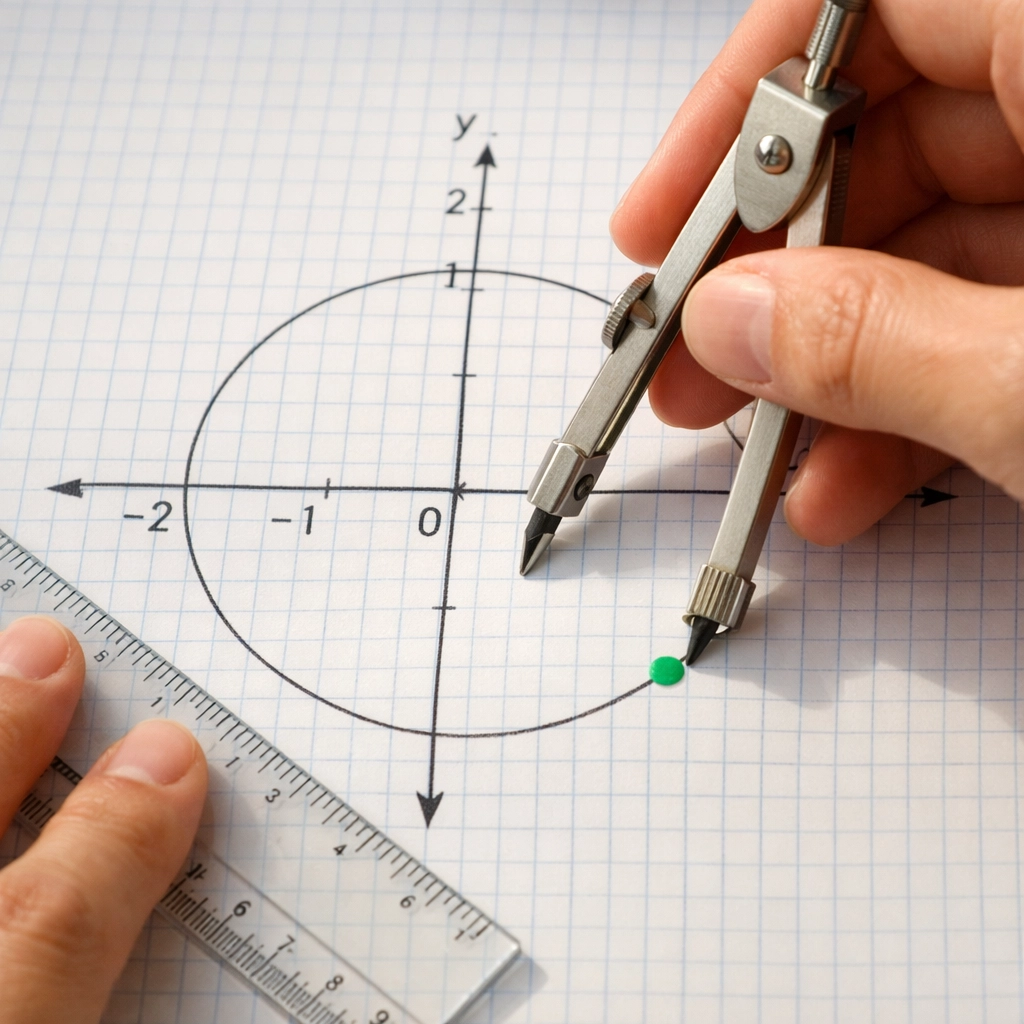
Here's the thing about arcs and sectors: you don't need separate formulas. Just find what fraction of 360° your central angle is, then apply that fraction to either the circumference (for arc length) or the area (for sector area).
Example: 90° angle in a circle with radius 8.
- 90/360 = 1/4 (a quarter of the circle)
- Arc length = (1/4) × 2π(8) = 4π
- Sector area = (1/4) × π(8²) = 16π
See? Once you find the fraction, the rest is automatic.
Your Next Move
Circle problems are all about pattern recognition and process. The SAT isn't trying to test if you're a geometry genius: they're testing if you can apply the same steps consistently under pressure.
Master these three skills:
- Completing the square without sign errors
- Using proportions for arcs and sectors
- Recognizing the standard form instantly
If you want more targeted practice, check out our full SAT prep resources. And if you're stuck on a specific problem type, our tutors are here to walk you through it step-by-step.
Now go crush those circle questions. You've got this. 🚀