SAT Mastery Series: Decoding the Past – History & Social Studies Passages (Module 6)
![[HERO] SAT Mastery Series: Decoding the Past – History & Social Studies Passages (Module 6)](https://cdn.marblism.com/WKnZ2HNQqly.webp)
You open your SAT Reading section, and there it is, a passage from 1787. Words like "enumerated powers" and "inviolable rights" stare back at you. Your heart sinks a little. Why does this sound like a different language?
Here's the truth: History and Social Studies passages are often the most intimidating part of the SAT Reading test. The language feels archaic. The arguments seem dense. And the pressure to read quickly while actually understanding what's being said? It's a lot.
But here's what most students don't realize: these passages follow predictable patterns. Once you know how to decode the structure and translate that old-school language into modern terms, these questions become some of the easiest points you'll score.
Welcome to Module 6 of the SAT Mastery Series. Today, we're cracking the code on History and Social Studies passages, and you're about to discover why "boring" doesn't have to mean "difficult."
Why History Passages Feel So Hard (And Why That's Actually Good News)
Let's start with the obvious: these passages aren't written for 21st-century teenagers. They're founding documents, political speeches, and historical arguments written 200+ years ago. The syntax is complex. The vocabulary is formal. And sometimes, you'll read three sentences before realizing you have no idea what just happened.
Sound familiar?
Here's the thing, the College Board knows this. That's exactly why they include these passages. They're not testing whether you can appreciate James Madison's writing style. They're testing whether you can extract meaning from challenging text, regardless of when it was written.
The good news? Once you learn to "translate" these passages in your head, they become predictable. The arguments follow logical structures. The questions focus on main ideas and viewpoints. And unlike fiction passages where you need to infer character motivations, History passages usually tell you exactly what they mean, you just have to get past the fancy language first.

The Theory: Dual Passages and Conflicting Viewpoints
Here's what makes History and Social Studies passages unique on the SAT: they love pairing two texts with opposing viewpoints.
You'll see Passage 1 argue that federal government needs more power, and Passage 2 argue the opposite. Or you'll get a historical document followed by a modern analysis that critiques it. The SAT wants to see if you can:
- Identify each author's main argument without getting lost in the details
- Recognize where the two passages agree or disagree
- Distinguish between what the text says and what it implies
This isn't about memorizing history facts. You could know absolutely nothing about the Federalist Papers and still ace these questions, because the answers are always in the text.
The key is understanding the structure. Most historical arguments follow this pattern:
- Opening claim: "Here's what I believe"
- Supporting evidence: "Here's why I believe it"
- Counterargument acknowledgment: "Some people think differently, but..."
- Conclusion: "Therefore, my position is correct"
Once you spot this structure, you're not reading archaic text anymore. You're just following a logical debate, one where you know exactly what to look for.
The Strategy: "The Modern Translation" Technique
Okay, let's get practical. How do you actually read these passages without your brain shutting down halfway through?
Introducing: The Modern Translation.
Here's how it works: As you read each complex sentence, immediately translate it into simple, modern language in your head. Don't try to memorize the exact wording. Instead, ask yourself: "What is this person actually saying?"
Let's practice with a real example. Imagine you're reading this sentence from a founding document:
"The powers not delegated to the United States by the Constitution, nor prohibited by it to the States, are reserved to the States respectively, or to the people."
Your brain might freeze on first read. But let's translate it:
Modern version: "If the Constitution doesn't give a power to the federal government or take it away from states, then the states or the people keep that power."
See the difference? Same meaning, way clearer.
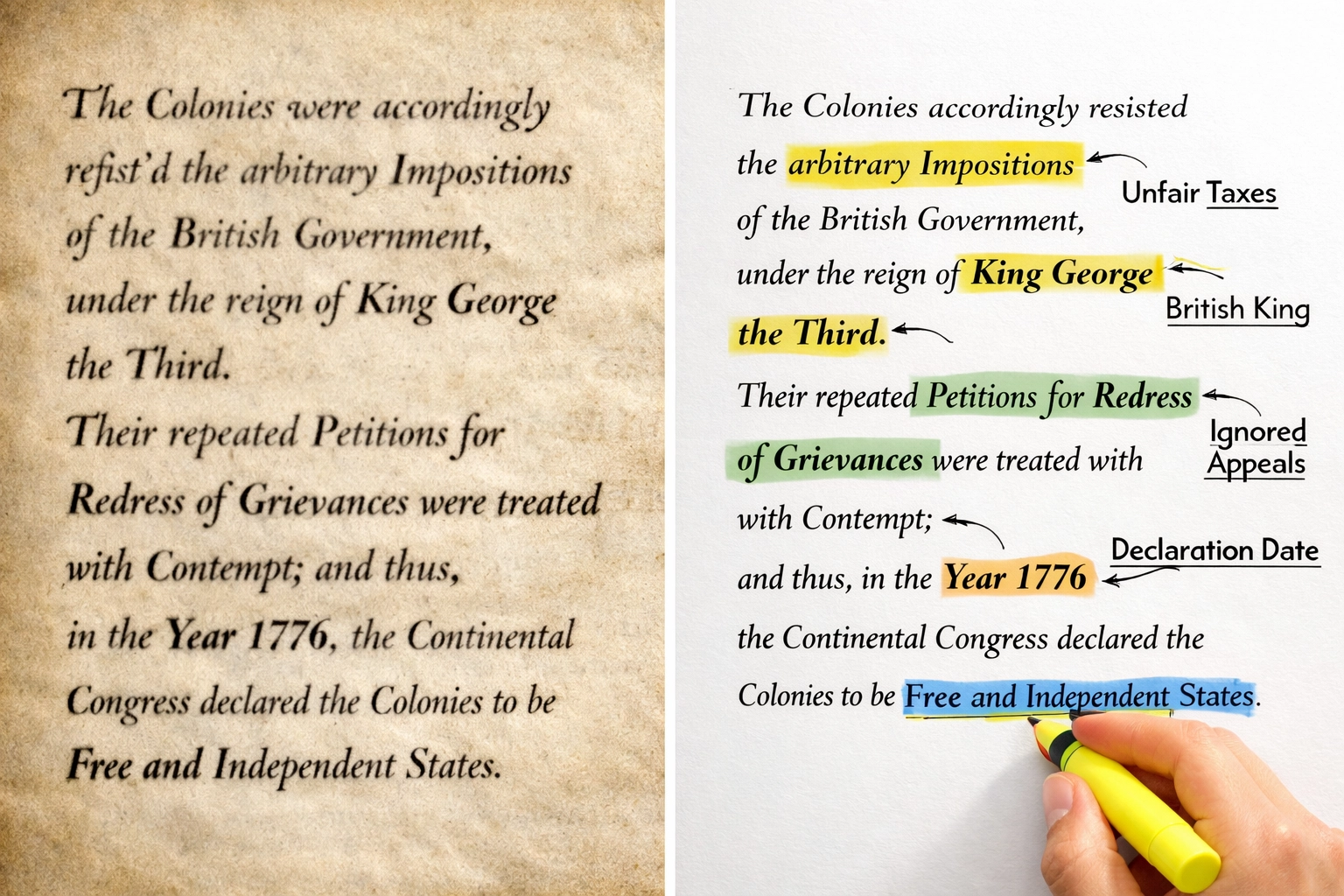
Here's your action plan for every History passage:
Step 1: Read the Introduction
The italicized intro tells you who wrote it and why. This context is gold, it primes your brain for what's coming.
Step 2: Chunk and Translate
Read one paragraph at a time. After each paragraph, pause and ask: "What did this paragraph say in plain English?" Mentally summarize it in 1-2 sentences max.
Step 3: Map the Argument
As you read, note the author's main claim and their supporting points. You don't need to write this down, just keep a mental map. "Okay, this person believes X because of Y and Z."
Step 4: Spot the Comparison (If It's a Dual Passage)
If you're reading two passages, don't stress about comparing them while you read. Finish Passage 1, translate it, then move to Passage 2. The comparison questions will be at the end anyway: you'll have time to think about how they relate.
Step 5: Answer Questions with the Text, Not Your Memory
Here's the biggest mistake students make: they read the passage, then try to answer questions from memory. Don't do this. Always go back to the relevant section and re-read it. The answers are right there: you just need to find them.
Practice: Using the 2020 SAT Test 1
Let's apply this to real SAT material. In the 2020 SAT Practice Test 1, you'll encounter History and Social Studies passages that perfectly illustrate what we've been talking about.
Example Scenario:
You get a paired passage. Passage 1 is from a historical document advocating for a certain political structure. Passage 2 is a modern critique of that same structure. Your job isn't to pick a side: it's to accurately represent what each author is saying.
When you approach the questions, they'll typically ask:
Main idea questions: "The primary purpose of Passage 1 is to..."
Translation: What's the author's main argument in one sentence?Evidence questions: "Which choice provides the best evidence for the previous answer?"
Translation: Find the sentence that directly supports what you just said.Comparison questions: "Both authors would most likely agree that..."
Translation: Where do their arguments overlap, even if they disagree on the big picture?
The beauty of these questions? They're testing reading comprehension, not history knowledge. You don't need to know what the Articles of Confederation were. You just need to understand what the text says about them.

How to Read Fast Without Missing Key Details
You've probably heard the advice: "Read faster on the SAT." But that's only half the story.
The real strategy isn't just speed: it's strategic reading. Here's how to move quickly through History passages without sacrificing comprehension:
Focus on Structure, Not Every Word
You don't need to read every single word with equal attention. Historical texts are wordy by nature. Instead, focus on:
- The first and last sentence of each paragraph (where main ideas usually live)
- Transitional phrases like "however," "therefore," "in contrast"
- Words that signal the author's opinion ("must," "should," "unfortunately")
Skip the Examples (For Now)
If a paragraph starts giving detailed historical examples or lists of evidence, skim it lightly. You can always come back if a question asks about specifics. What matters first is the argument, not every supporting detail.
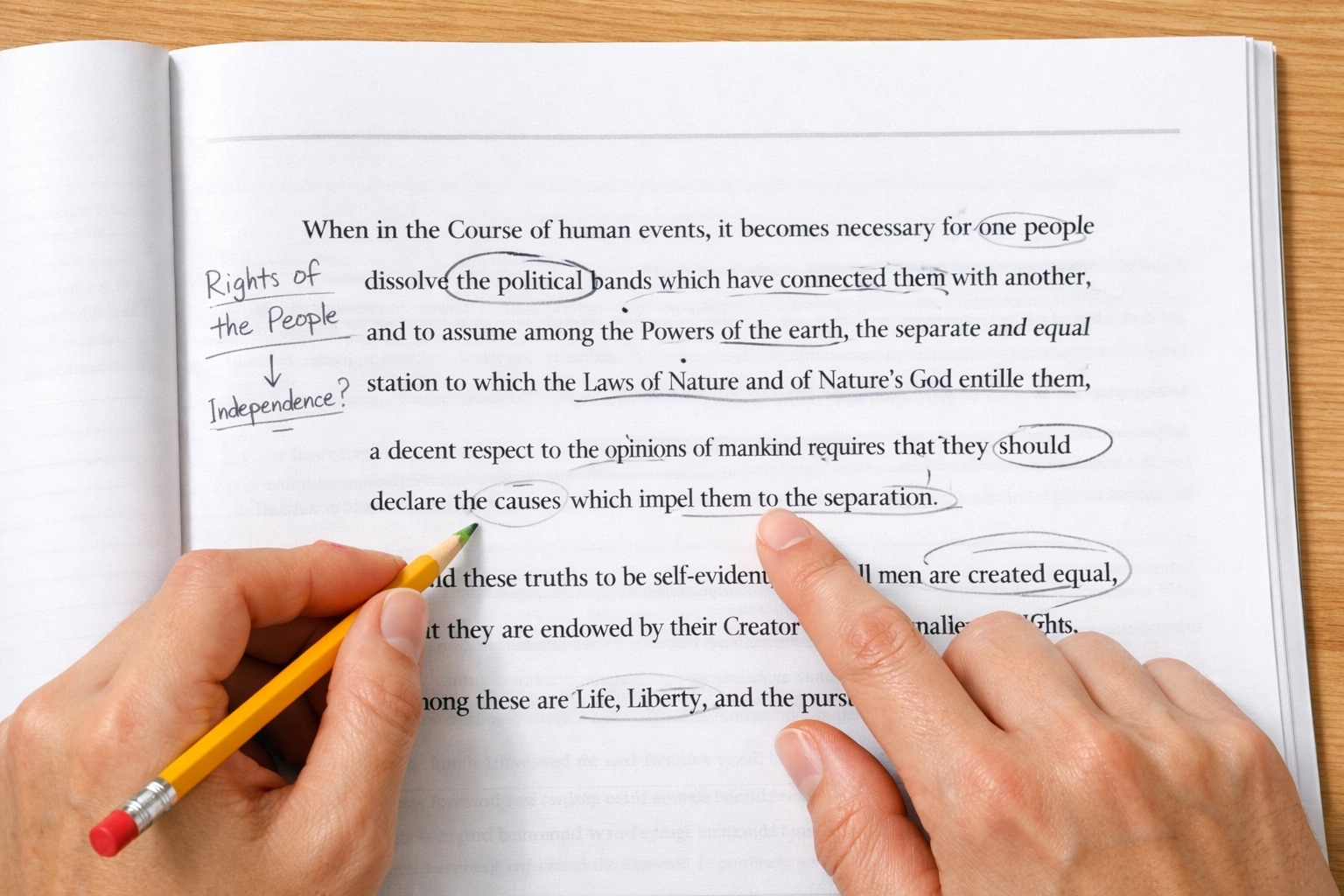
Use Your Pencil
Circle or underline the main claim of each passage as you read. Mark where Passage 2 disagrees with Passage 1 if it's a paired set. These tiny annotations save huge time when you're hunting for answers later.
Trust the Translation
Remember: you're not trying to memorize fancy language. You're extracting meaning. If you can explain the passage's argument to a friend in simple terms, you understand it well enough to answer the questions.
Tutor Script: Keeping Students Engaged with "Dry" Texts
Let's be real: History passages can feel boring. Students check out mentally because they think they're reading homework, not a test.
Here's how we keep engagement high:
Reframe the Task
Instead of "reading a passage," you're solving a puzzle. The author hid their argument inside complex language. Your job is to decode it. It's a challenge, not a chore.
Celebrate the "Aha" Moments
When you translate a confusing sentence into something clear, that's a win. Acknowledge it. "See? You just decoded 18th-century English. That's a flex."
Connect to Modern Issues
Most historical arguments are about timeless debates: individual rights vs. collective good, centralized power vs. local control. Point out that these same debates happen today: we just use different words. Suddenly, the text feels relevant.
Normalize Confusion
If a sentence doesn't make sense on first read, that's normal. Even the best readers re-read complex text. The difference is, strong readers don't panic: they just translate and move on.
Your Practice Game Plan
Ready to put this into action? Here's your next step:
- Grab the 2020 SAT Practice Test 1 (available free from the College Board)
- Find the History/Social Studies passage in the Reading section
- Apply the Modern Translation technique as you read
- Answer the questions, going back to the text for evidence
- Check your answers and identify patterns in what you missed
The goal isn't perfection on your first try. The goal is to practice the process: chunking, translating, mapping arguments, and finding textual evidence.
If you want personalized support as you work through these strategies, check out our appointments page to connect with a tutor who can guide you through real SAT passages one-on-one.
The Bottom Line
History and Social Studies passages aren't hard because they require background knowledge. They're hard because the language is unfamiliar and the arguments feel abstract.
But once you learn to translate complex text into modern language, recognize argument structures, and answer questions with evidence from the passage, these questions become predictable. And predictable means scoreable.
You don't need to love reading old documents. You just need to know how to decode them. And now? You do.
Ready to keep building your SAT mastery? Check out our full study resources to stay on track with your prep. You've got this.