SAT Mastery Series: Grammar Gold – Standard English Conventions (Module 4)
![[HERO] SAT Mastery Series: Grammar Gold – Standard English Conventions (Module 4)](https://cdn.marblism.com/llqzbGzeQHF.webp)
Let's be honest: grammar isn't exactly the subject that gets you pumped up in the morning. You're probably thinking, "Great, another lecture about commas and verb tenses." But here's the thing: the SAT Writing & Language section isn't testing whether you can recite grammar rules like a robot. It's testing whether you can hear what sounds right and spot what's wrong in under 30 seconds per question.
And guess what? You already know most of this stuff. You just need the right strategies to unlock it.
Welcome to Module 4 of the SAT Mastery Series: Grammar Gold. This is where we turn Standard English Conventions from a confusing mess into your secret weapon for easy points. No boring drills. No memorizing dozens of exceptions. Just practical, battle-tested techniques that work.
Why Grammar Matters (More Than You Think)
The Writing & Language section makes up half of your Evidence-Based Reading and Writing score. That's 200-400 points on the line. And here's the best part: grammar questions are the most predictable questions on the entire SAT.
Unlike reading comprehension where passages can throw curveballs, grammar rules don't change. Subject-verb agreement worked the same way in 1995 as it does today. Once you learn the patterns, you're basically printing points.
But there's a catch. The SAT loves to bury simple grammar errors inside complicated sentences. That's where most students stumble. You see a sentence that's 30 words long with three commas, and suddenly your brain starts second-guessing everything.
That's exactly what we're going to fix.
The Foundation: Subject-Verb Agreement
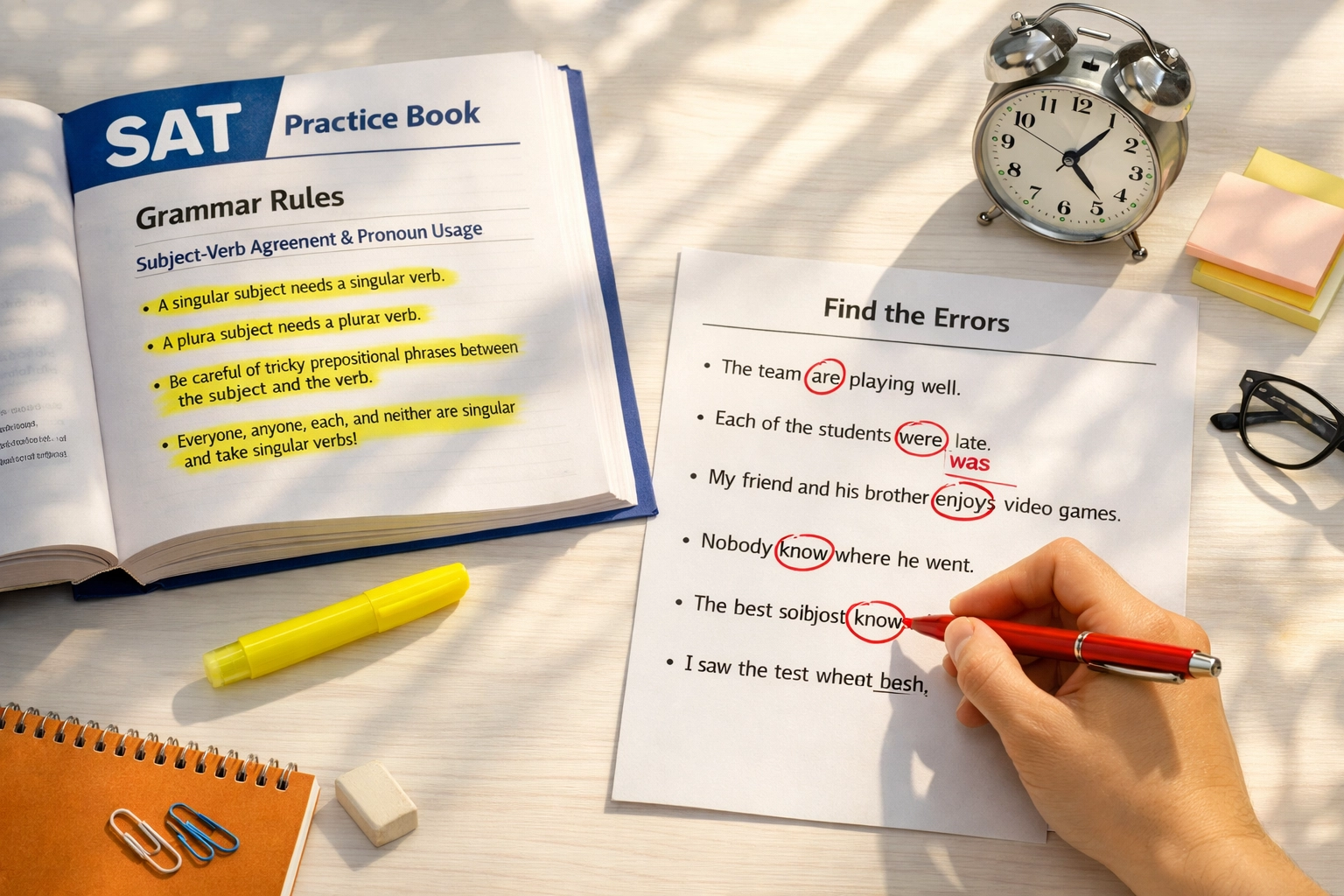
Subject-verb agreement sounds fancy, but it's actually simple: singular subjects need singular verbs, and plural subjects need plural verbs. The problem? The SAT doesn't make it easy to see.
The Trap: They'll stick a bunch of words between the subject and the verb to confuse you.
Here's an example:
"The collection of rare books were donated to the library."
Sounds fine, right? Wrong. The subject isn't "books": it's "collection." Collections are singular. So it should be "was donated," not "were donated."
Your Strategy: Delete the Noise
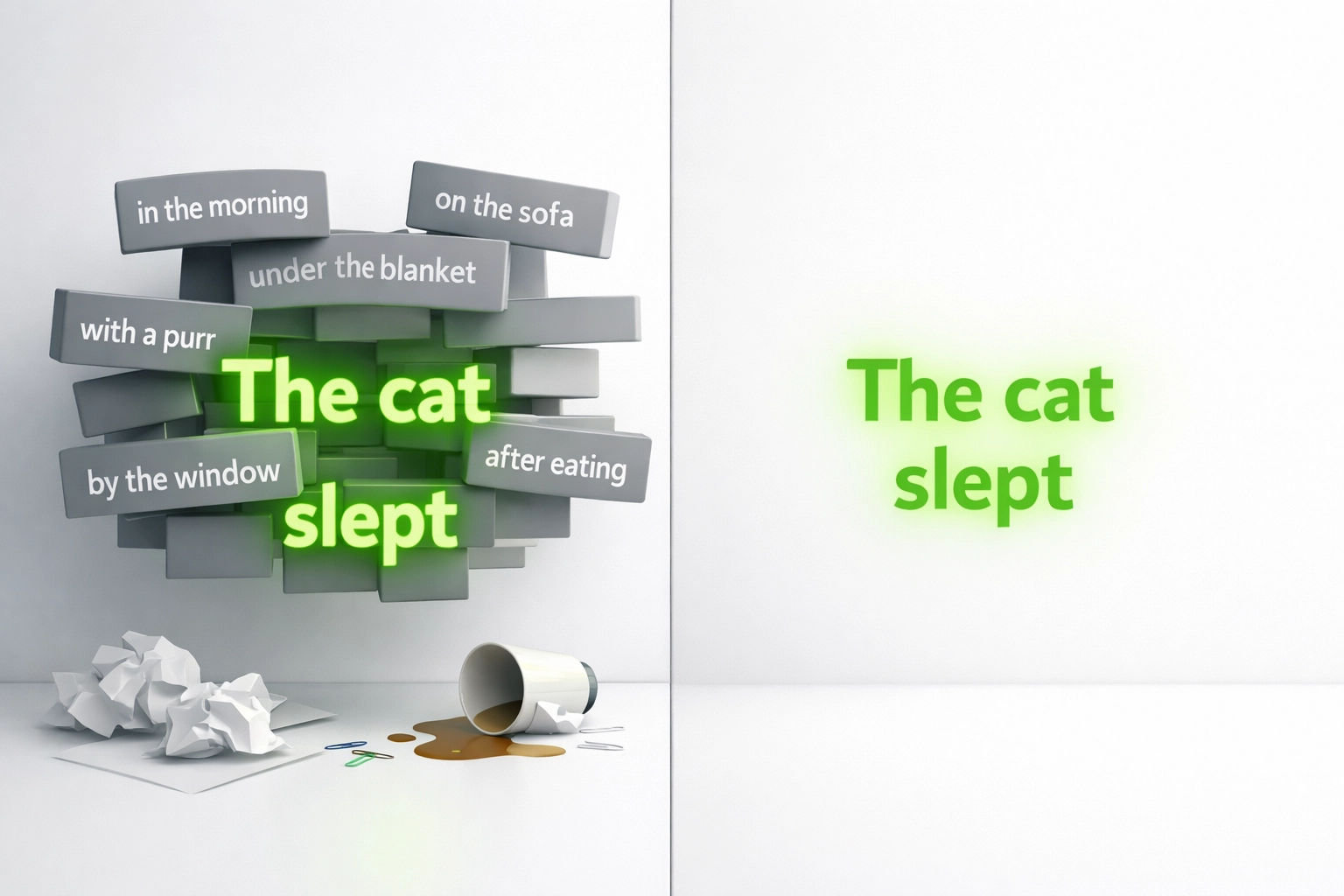
This is your new superpower. When you see a long sentence, mentally cross out everything between the subject and the verb. All those prepositional phrases, clauses, and descriptive words? They're just noise.
Try it again:
"The collection of rare books were donated to the library."
Now it's obvious. "The collection were" sounds wrong. It should be "The collection was."
Practice Round:
Which is correct?
A) The team of scientists are conducting experiments.
B) The team of scientists is conducting experiments.
Delete the noise: "The team of scientists is conducting experiments."
Answer: B. "Team" is singular, even though it's made up of multiple scientists.
Pronoun Clarity: Who's Doing What?
Pronouns are those little words like "he," "she," "it," "they," and "their" that replace nouns. The SAT loves to test whether pronouns clearly refer to the right person or thing.
The Trap: Ambiguous pronouns.
Check this out:
"When Sarah met Emily at the café, she ordered a cappuccino."
Who ordered the cappuccino? Sarah or Emily? You literally can't tell. That's a pronoun error.
Your Strategy: The Pronoun Must Have ONE Clear Boss
Every pronoun needs a clear antecedent (the noun it refers to). If you can't immediately identify what the pronoun is replacing, it's wrong.
Another Common Mistake: Pronoun-Antecedent Agreement
Singular antecedents need singular pronouns. Plural antecedents need plural pronouns.
"Every student should bring their calculator."
Sounds natural in conversation, but technically wrong on the SAT. "Every student" is singular, so it should be "his or her calculator." (Though the SAT is slowly adapting to singular "they": watch for context clues.)
Practice Round:
"Each of the athletes must submit their medical forms before practice."
What's wrong? "Each" is singular, but "their" is plural. It should be "his or her medical forms."
The Delete the Noise Method: Your Secret Weapon
We touched on this earlier, but let's dive deeper because this strategy will save you so much time.
Most SAT grammar questions hide the error inside complex sentences packed with descriptive clauses, prepositional phrases, and extra information. Your job isn't to understand every word: it's to find the core sentence.
Step 1: Find the subject (who or what is doing the action).
Step 2: Find the verb (the action).
Step 3: Cross out everything in between.
Step 4: Check if they agree.

Let's use a real example from the 2020 SAT Test:
"The data from the surveys, which were conducted across multiple states and demographics, suggests significant trends."
Looks intimidating, right? Not anymore.
Delete the noise: "The data from the surveys, which were conducted across multiple states and demographics, suggests significant trends."
Now it's clear: "The data suggests." But wait: is "data" singular or plural? Trick question! In formal writing (like the SAT), "data" is technically plural. So it should be "suggest," not "suggests."
This method works for punctuation errors, too. If you're checking comma placement or verb tense, strip away the extras and focus on the skeleton of the sentence.
Practice Time: Real SAT Questions
Let's apply everything you've learned. Here are modified examples based on 2020 SAT patterns:
Question 1:
"The museum's collection of ancient artifacts, along with its interactive exhibits, have attracted thousands of visitors."
A) NO CHANGE
B) has attracted
C) were attracting
D) are attracting
Your Process:
Delete the noise: "The museum's collection of ancient artifacts, along with its interactive exhibits, have attracted thousands of visitors."
"The collection have attracted" sounds wrong. Collections are singular. Answer: B) has attracted
Question 2:
"Neither the teachers nor the principal were aware of the schedule change."
A) NO CHANGE
B) was
C) are
D) is
Your Process:
With "neither/nor" constructions, the verb agrees with the noun closest to it. "The principal" is singular, so it should be "was aware." Answer: B) was
Tutor Tips: Making Grammar Stick (Without the Boredom)
Here's how you actually learn this stuff instead of just reading about it:
1. Read Your Answers Out Loud
Your ear is smarter than you think. If something sounds clunky or weird when you say it, it's probably wrong.
2. Create Cheat Sheet Flashcards
Don't memorize definitions. Write down the pattern and one example:
"Subject-Verb Agreement → The team IS (not are)"
3. Do Timed Mini-Drills
Spend 10 minutes a day on 5 grammar questions. Speed + accuracy = confidence on test day.
4. Teach Someone Else
Explain the Delete the Noise method to a friend, parent, or even your pet. If you can teach it, you own it.
5. Track Your Patterns
Keep a list of the grammar rules you keep missing. Most students have 2-3 weak spots. Once you identify yours, you can target them.
What's Next in Your Mastery Journey
Grammar might not be glamorous, but it's reliable. These questions are your safety net: the ones you can count on when reading comprehension gets tough or the math section throws you a curveball.
Master subject-verb agreement and pronoun clarity, and you've already locked in a solid chunk of points. Add in the Delete the Noise method, and you're working faster and more accurately than 70% of test-takers.
Ready to keep building your SAT toolkit? Check out Module 1: Heart of Algebra if you need a math refresher, or explore our complete study plan guide to see how all these modules fit together.
You've got this. One module at a time, one concept at a time, one point at a time. Let's keep moving forward.
Coming Up in Module 5: We're tackling Passport to Advanced Math: quadratics, exponentials, and the formulas that actually matter. Stay tuned.