SAT Mastery Series: Leveling Up – Passport to Advanced Math (Module 5)
![[HERO] SAT Mastery Series: Leveling Up – Passport to Advanced Math (Module 5)](https://cdn.marblism.com/LYlp8Boxx5g.webp)
You know that moment when you see a quadratic equation on the SAT and your brain just... freezes? When the numbers and exponents blur together and you wonder if you'll ever actually get this stuff?
You're not alone. Passport to Advanced Math, the SAT's fancy term for quadratics, exponentials, and polynomial functions, trips up more students than any other math section. Not because you're bad at math. But because nobody taught you how to see the patterns hiding in plain sight.
That stops today. Welcome to Module 5 of the SAT Mastery Series, where we're going to crack the code on advanced math using one game-changing hack: Structure Recognition.
Why Passport to Advanced Math Matters (And Why It Feels So Hard)
Let's get real for a second. Passport to Advanced Math makes up roughly 16 of the 58 math questions on the SAT. That's almost 28% of your math score riding on your ability to manipulate equations, recognize function behavior, and work with non-linear relationships.
The problem? Most students approach these questions like they're solving a puzzle with no picture on the box. You're taught formulas, quadratic formula, vertex form, factoring rules, but nobody shows you how to recognize which tool to grab when you're staring down a problem under time pressure.

That's where Structure Recognition comes in. It's not about memorizing more formulas. It's about training your brain to spot the shape of a problem in seconds, so you know exactly what move to make next.
The Theory: Quadratic Equations and Parabolas Decoded
Before we dive into strategy, let's nail down the fundamentals. A quadratic equation is any equation that can be written in the form:
y = ax² + bx + c
This creates a U-shaped curve called a parabola when you graph it. Here's what you need to internalize:
- If a is positive, the parabola opens upward (like a smile)
- If a is negative, it opens downward (like a frown)
- The vertex is the highest or lowest point on the curve
- The axis of symmetry is the vertical line that cuts the parabola perfectly in half
The SAT loves asking you about:
- Finding the vertex of a parabola
- Identifying x-intercepts (where the graph crosses the x-axis)
- Rewriting equations in different forms to reveal specific features
Here's the kicker: there are three main forms for quadratic equations, and each one reveals different information instantly.
Standard Form: y = ax² + bx + c
→ Shows you the y-intercept (where the graph crosses the y-axis)
Vertex Form: y = a(x - h)² + k
→ Shows you the vertex at point (h, k)
Factored Form: y = a(x - p)(x - q)
→ Shows you the x-intercepts at x = p and x = q
Most students panic when they see a quadratic because they think they need to solve it completely. But on the SAT? You just need to recognize which form gives you the answer fastest.
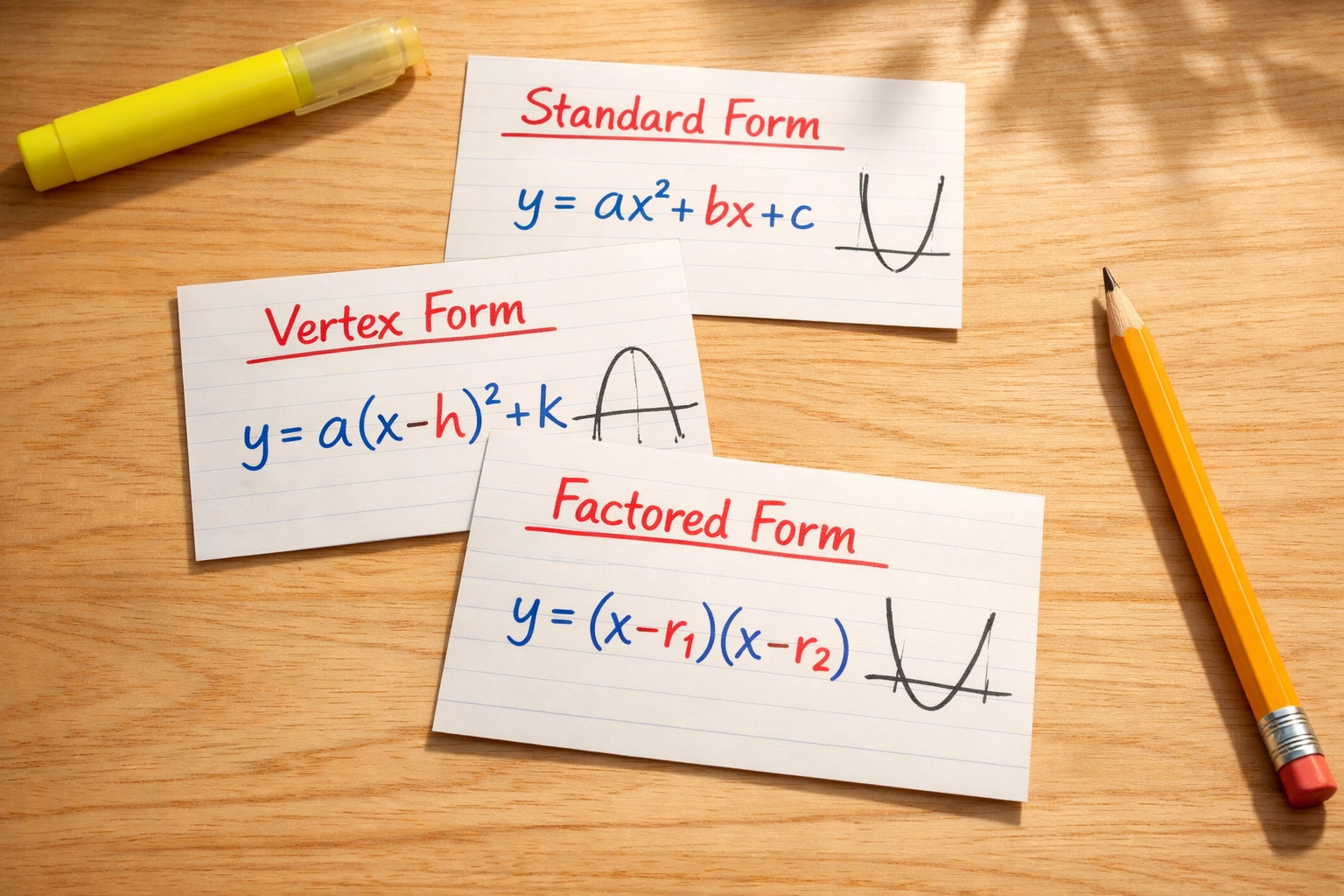
The Strategy: Structure Recognition in Action
Here's the hack that changes everything: Don't solve. Recognize.
When you see a quadratic equation on the SAT, your first move isn't to start calculating. It's to ask yourself three questions:
1. What is the question actually asking for?
Are they asking for the vertex? The y-intercept? The x-intercepts? The axis of symmetry?
2. Which form of the equation reveals that information?
Match what they're asking to the form that shows it directly.
3. Can I convert to that form quickly, or is there a shortcut?
Sometimes the SAT gives you the equation already in the perfect form. Sometimes you need to complete the square or factor. Sometimes you can just plug in values and test.
Let's walk through a real example from the 2020 SAT Math Test 1:
Example: The function f is defined by f(x) = 2x² - 8x + 5. What is the minimum value of f(x)?
Most students see this and immediately reach for the quadratic formula or start graphing. But check this out:
- What are they asking? The minimum value, that's the y-coordinate of the vertex
- Which form reveals this? Vertex form: y = a(x - h)² + k
- How do we convert? Complete the square
Here's the move:
f(x) = 2x² - 8x + 5
f(x) = 2(x² - 4x) + 5
f(x) = 2(x² - 4x + 4 - 4) + 5
f(x) = 2(x - 2)² - 8 + 5
f(x) = 2(x - 2)² - 3
Done. The vertex is at (2, -3), so the minimum value is -3. Total time: 45 seconds instead of 2 minutes with the quadratic formula.
That's Structure Recognition. You're not doing more math. You're doing smarter math.

Practice Time: Real SAT Questions
Let's test your new superpower with these adapted questions from 2020 SAT Math Test 1. Don't just solve them, recognize the structure first.
Question 1:
The graph of y = (x - 3)(x + 1) in the xy-plane is a parabola. What is the x-coordinate of the vertex?
Before you calculate anything, ask: What form is this equation in? (Factored form.) What does that tell you? (The x-intercepts are at x = 3 and x = -1.) Where's the vertex? (Halfway between the intercepts.)
The vertex x-coordinate = (3 + (-1))/2 = 1
Question 2:
If f(x) = x² + 6x + k has a minimum value of 4, what is the value of k?
Structure check: They're asking about the minimum value (the y-coordinate of the vertex), and you know it's 4. Convert to vertex form:
f(x) = (x + 3)² - 9 + k
The minimum value is -9 + k = 4, so k = 13.
Question 3:
The function g is defined by g(x) = -x² + 4x - 1. For what value of x does g(x) reach its maximum?
The parabola opens downward (negative a), so you're looking for the vertex. Use the axis of symmetry formula: x = -b/(2a) = -4/(2(-1)) = 2.
See the pattern? You're not grinding through algebra. You're recognizing what the question wants and grabbing the right structural tool.
The Tutor Script: Coaching Through the Chaos
When your students are stressed, paralyzed by a quadratic they don't recognize, here's how to guide them back:
"Hey, take a breath. Let's not solve this yet. Just tell me: what's the question actually asking for?"
Wait for their answer. Make them articulate it.
"Good. Now look at the equation. What form is it in right now? Standard? Vertex? Factored?"
If they don't know, help them identify it.
"Okay, so if they're asking for [the vertex/x-intercepts/y-intercept], and we have [standard/vertex/factored] form, what do we need to do? Can we convert it, or is there info we can pull right now?"
Walk them through the decision tree, not the calculation. Once they see the structure, the math becomes automatic.
"You just saved yourself 90 seconds. That's the difference between rushing through the test and finishing early. You're not bad at math: you just needed to see the pattern."
This language reframes struggle as a skill-building moment. You're not rescuing them. You're teaching them to recognize the map.
Your Next Move
Passport to Advanced Math isn't about memorizing more formulas. It's about training yourself to see the architecture of equations: to recognize patterns so quickly that the SAT's hardest math questions start feeling like patterns you've solved a hundred times before.
Here's your action plan:
- Print out 10 quadratic questions from official SAT practice tests
- Before solving each one, identify what form it's in and what form would answer the question fastest
- Time yourself: how long does it take to recognize the structure vs. solve the whole problem?
- Keep a "pattern log": write down the 3-5 structures you see most often
The more you practice Structure Recognition, the faster your brain will categorize problems on test day. You'll stop seeing scary equations and start seeing familiar patterns with obvious solutions.
Want more targeted practice on your specific weak spots? Check out our personalized SAT study plans designed around how you actually learn.
You've got this. Now go level up. 🚀