SAT Mastery Series: Reading Deep Dive – Main Idea & Purpose (Module 12)
![[HERO] SAT Mastery Series: Reading Deep Dive – Main Idea & Purpose (Module 12)](https://cdn.marblism.com/QVMtd9WJWnr.webp)
You just read a 600-word passage about marine biology. You understood every word. You even found it interesting. Then you hit the question: "What is the primary purpose of this passage?"
And suddenly, your brain goes blank.
You're not alone. Main Idea and Purpose questions are some of the trickiest on the SAT Reading section, not because they're complicated, but because they require you to zoom out when your instinct is to zoom in. After diving deep into the details of a passage, pulling back to see the big picture feels counterintuitive.
That's exactly what we're fixing today.
The "What" vs. The "Why": Understanding Main Idea and Purpose
Here's the fundamental distinction that trips up most students:
Main Idea = WHAT the passage is about Purpose = WHY the author wrote it
Let's say you're reading a passage about the decline of coral reefs. The main idea might be "Coral reefs are experiencing rapid decline due to ocean acidification." But the purpose? That's different. The author's purpose could be "to persuade readers to support environmental legislation" or "to explain the scientific mechanisms behind ecosystem collapse."
See the difference? One describes the content; the other describes the author's intention.
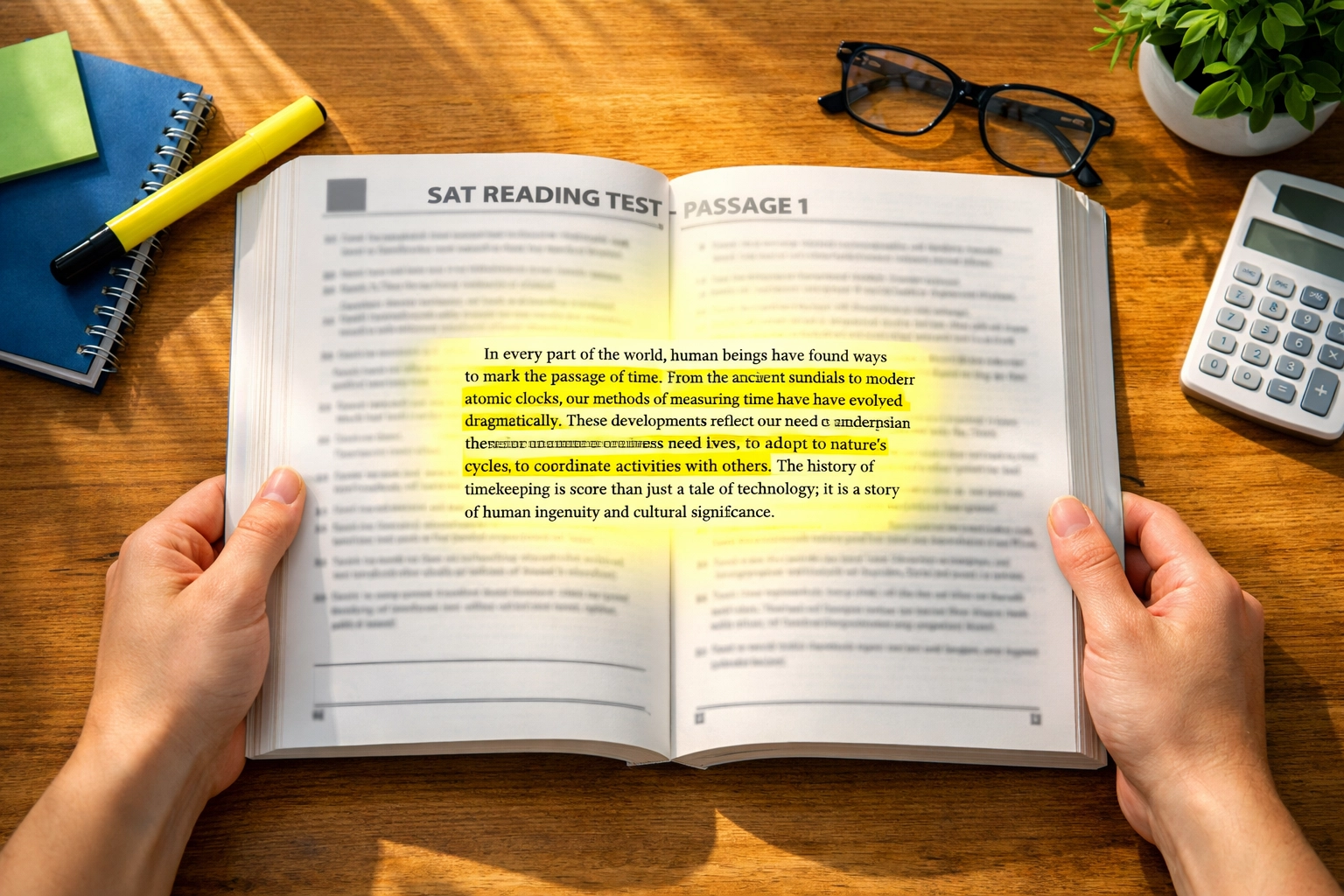
The Zoom Out Technique: Your New Superpower
When you're knee-deep in a passage about Elizabethan theater or quantum mechanics, it's easy to get lost in the weeds. The Zoom Out technique forces you to step back and ask yourself:
"If I had to explain this passage to someone in one sentence, what would I say?"
Try this mental exercise: Imagine you're texting a friend about what you just read. You wouldn't send them every detail, you'd give them the essence. That's your main idea.
Then ask the follow-up: "Why did the author bother writing this?"
Were they trying to change your mind about something? Inform you about new research? Critique an existing theory? That's your purpose.
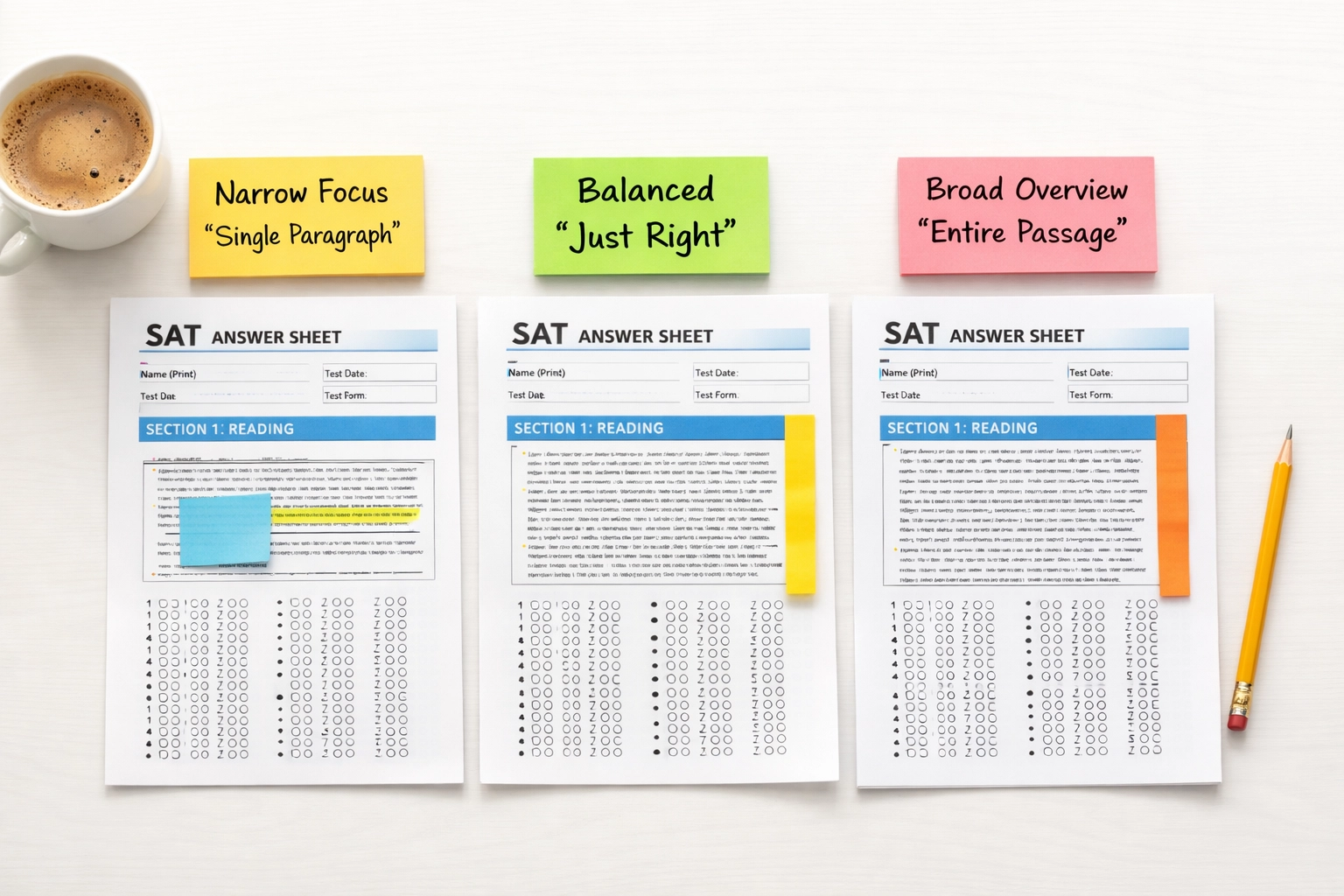
Strategy: Spotting "Too Narrow" and "Too Broad" Answer Choices
The SAT loves to mess with you by offering answer choices that are technically true but wrong for the question. Here's how they do it:
Too Narrow: The answer focuses on one paragraph or one example instead of the whole passage. It's like saying the main idea of a movie is "a car chase", sure, that happened, but it's not what the movie is about.
Too Broad: The answer is so general it could apply to dozens of passages. "This passage discusses human behavior" might be true, but it tells you nothing specific.
Your job? Find the Goldilocks answer, not too specific, not too vague, but just right.
Anchor Yourself: First and Last Sentences
Here's a tutor secret: The first and last sentences of paragraphs are gold mines for main idea questions. Why? Because that's where authors typically signal their central claims and conclusions.
The First Sentence often introduces what's coming. It sets up the topic.
The Last Sentence often delivers the punchline. It wraps up the point or transitions to the next idea.
If you're running short on time or feeling overwhelmed, skim these anchor sentences. They'll give you the backbone of the passage's argument.

Practice Question #1: The "Half-Right" Trap
Let's walk through a question together with a full tutor script. This is how you should be thinking through these problems:
Passage Excerpt: "While early conservationists focused primarily on preserving wilderness areas, modern environmental science recognizes that human communities and natural ecosystems are deeply interconnected. This shift has led to new approaches that integrate local knowledge and economic sustainability into conservation efforts."
Question: Which choice best describes the main idea of the passage?
A) Early conservationists made mistakes in their preservation efforts. B) Modern environmental science has completely replaced older conservation methods. C) Conservation approaches have evolved to recognize the connection between human and natural systems. D) Local communities possess valuable knowledge about ecosystems.
Tutor Script: How to Think Through This
Student instinct: "Oh, A sounds right because it mentions early conservationists, and that's in the passage."
Tutor response: "Hold on, let's apply the 'too narrow vs. too broad' test. Does the passage spend most of its time criticizing early conservationists? Or is that just the setup for the real point?"
Student: "I guess it's more about the shift to modern approaches..."
Tutor: "Exactly! A is a trap, it's true but misses the main idea. Now look at B. What word makes you suspicious?"
Student: "Completely?"
Tutor: "Bingo. Extreme words like 'completely' or 'always' are red flags. The passage says there's been a shift, not a total replacement. What about D?"
Student: "That's only mentioned at the end."
Tutor: "Right: it's a supporting detail, not the main idea. That leaves C, which captures the 'shift' and the 'interconnection' that the whole passage is building toward. That's your answer."
Answer: C
Practice Question #2: Purpose vs. Main Idea
Passage Excerpt: "Recent studies have challenged the long-held belief that multitasking improves productivity. Neuroscientists now understand that the brain doesn't truly multitask: it rapidly switches between tasks, resulting in decreased efficiency and increased errors. For students and professionals alike, these findings suggest that focused, single-task work produces better outcomes."
Question: The primary purpose of the passage is to:
A) Describe how the brain processes multiple tasks B) Argue that single-task focus is superior to multitasking C) Explain why multitasking is popular among students D) Present recent neuroscience research findings
Tutor Script: Finding the "Why"
Tutor: "This is a PURPOSE question, not a main idea question. That's crucial. We're looking for the author's intention. Let's evaluate each choice."
Student: "A seems right: the passage talks about brain processing."
Tutor: "That's what the passage mentions, but is that why the author wrote it? What's the movement of the passage? It starts with 'challenged the long-held belief' and ends with 'these findings suggest.' What's happening there?"
Student: "The author is trying to convince us of something?"
Tutor: "Exactly! The author is making an argument based on the research. Look at B: it captures that persuasive purpose. A is too descriptive, C isn't addressed at all, and D is technically true but misses the argumentative angle. The author isn't just reporting research: they're using it to make a point about work habits."
Answer: B
Practice Question #3: Eliminating the "Half-Right" Answer
Passage Excerpt: "Urban gardens have transformed abandoned lots in Detroit into thriving community spaces. These gardens not only provide fresh produce in food deserts but also create opportunities for neighbors to connect, learn agricultural skills, and take pride in their neighborhoods. What began as a grassroots response to economic decline has evolved into a model for urban resilience."
Question: The main idea of the passage is that:
A) Detroit has experienced significant economic decline B) Urban gardens have multiple benefits for communities C) Food deserts are a serious problem in urban areas D) Grassroots movements can address economic challenges
Tutor Script: The Evidence vs. Conclusion Shift
Tutor: "This is where students get trapped by 'half-right' answers. Let's identify what's evidence and what's the conclusion. What facts does the passage give us?"
Student: "That Detroit had economic decline and food deserts."
Tutor: "Right: those are the setup, the context. Now what's the passage's conclusion: the point it's making using those facts?"
Student: "That urban gardens help in multiple ways?"
Tutor: "Exactly. A and C are just background information: true but not the main idea. D is interesting because it sounds big and important, but does the passage focus on grassroots movements in general? Or specifically on urban gardens?"
Student: "Urban gardens specifically."
Tutor: "That's the key. D is too broad. The passage isn't making a grand statement about all grassroots movements: it's making a specific point about urban gardens. B nails it because it captures the 'multiple benefits' thread that runs through the entire passage."
Answer: B

Your Action Plan: From Theory to Score Improvement
Now that you understand the distinction between "what" and "why," and you've seen how to eliminate trap answers, here's your practice protocol:
Step 1: Take three official SAT Reading passages and identify every Main Idea or Purpose question.
Step 2: Before looking at the answer choices, write your own one-sentence summary of the passage and the author's purpose.
Step 3: Now look at the choices and eliminate using the "too narrow/too broad" filter.
Step 4: For any question you get wrong, write out your own tutor script explaining why the wrong answers are traps and why the right answer works.
The difference between a 650 and a 720 on SAT Reading often comes down to these big-picture questions. Master them, and you're not just improving your score: you're developing critical reading skills that will serve you through college and beyond.
Ready to put this into practice with real SAT passages? Book a session with our expert tutors who can walk you through personalized strategies tailored to your reading style.
The big picture is waiting for you. Time to zoom out.