SAT Mastery Series: Geometry Deep Dive – Mastering Circles & Angles (Module 8)
![[HERO] SAT Mastery Series: Geometry Deep Dive – Mastering Circles & Angles (Module 8)](https://cdn.marblism.com/Xc9A9lL7N8z.webp)
Welcome to Module 8 of the SAT Mastery Series! If you've been avoiding geometry questions, especially the ones with circles, you're not alone. These problems have a reputation for being visual nightmares, full of hidden angles and weird formulas you barely remember. But here's the truth: SAT geometry isn't testing how well you memorized theorems. It's testing whether you can see what's actually there.
Today, we're diving deep into circles, angles, and the classic "redraw and label" strategy that turns confusing diagrams into easy wins. This module is 70% practice because that's what your tutors and students need most, real questions with exhaustive, step-by-step breakdowns that show why each move works.
Let's get started.
The Core Theory: Circle Theorems You Actually Need
You don't need to memorize 47 theorems. You need four core concepts that cover 95% of SAT circle problems:
1. Central Angles & Arc Length
A central angle is measured from the center of the circle. The arc it creates is proportional to the angle. If the central angle is 60° out of 360°, the arc is 60/360 (or 1/6) of the total circumference.
2. Sector Area
A sector is a "pizza slice" of the circle. Its area is the same fraction of the total circle area as the central angle is of 360°. Formula: (θ/360) × πr² where θ is your central angle in degrees.
3. Inscribed Angles
An inscribed angle (vertex on the circle) is always half the central angle that subtends the same arc. This one trips people up constantly.
4. Tangent Lines
A tangent line touches the circle at exactly one point and is always perpendicular (90°) to the radius at that point. When you see a tangent, you've got a right angle hiding somewhere.
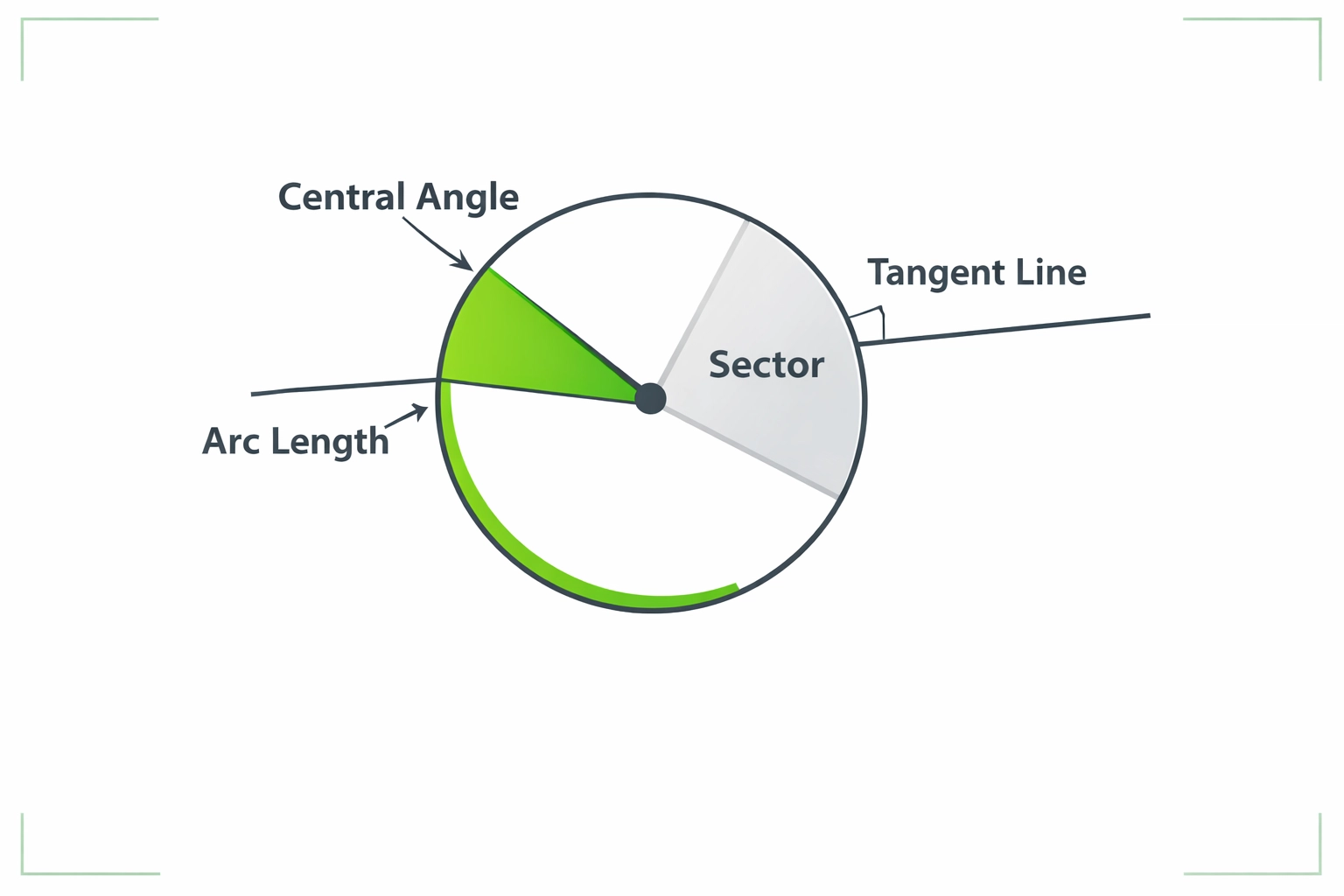
That's it. Master these four, and you're already ahead of most test-takers.
The Strategy: Redraw & Label
Here's your secret weapon: don't trust the diagram as-is. The SAT loves giving you messy, unlabeled circles that feel impossible. Your job is to redraw it in a way that makes the relationships obvious.
The Redraw & Label Process:
- What do we know? Write down every measurement, angle, and relationship mentioned in the problem.
- Sketch a cleaner version. Seriously. Draw it yourself with clear labels.
- Mark all the relationships. If there's a tangent, mark the 90° angle. If there's a central angle, find the arc.
- Ask: What's missing? Often, the answer is hiding in a relationship you haven't drawn yet.
This isn't busywork, it's how you avoid careless mistakes and see connections the test wants you to miss.
Practice Questions with Step-by-Step Solutions
Alright, here's where we roll up our sleeves. These are SAT-style questions modeled after the 2020 SAT Test 1 and similar high-difficulty problems. Each one has an exhaustive breakdown so your tutors can walk students through every single step.
Question 1: Arc Length Challenge
Problem: Circle O has a radius of 9. Central angle AOB measures 80°. What is the length of arc AB?
Step 1: What do we know?
- Radius = 9
- Central angle = 80°
- Formula for arc length = (θ/360) × 2πr
Step 2: Plug in the values
Arc length = (80/360) × 2π(9)
Arc length = (2/9) × 18π
Arc length = 4π
Answer: 4π (or approximately 12.57 if the question asks for a decimal)
Tutor Tip: Always ask students, "What fraction of the circle does 80° represent?" Getting them to see it as 80/360 helps them understand why the formula works.
Question 2: Sector Area
Problem: In circle P, a sector has a central angle of 120° and a radius of 6. What is the area of the sector?
Step 1: What do we know?
- Central angle = 120°
- Radius = 6
- Sector area formula = (θ/360) × πr²
Step 2: Calculate
Sector area = (120/360) × π(6²)
Sector area = (1/3) × 36π
Sector area = 12π
Answer: 12π (approximately 37.7 if decimal)
Tutor Tip: Point out that 120° is exactly 1/3 of 360°. Students who see this don't need to rely on memorization: they understand the logic.

Question 3: Inscribed Angle Trap
Problem: In circle Q, inscribed angle ABC intercepts arc AC, which measures 140°. What is the measure of angle ABC?
Step 1: What do we know?
- Arc AC = 140°
- Angle ABC is inscribed (vertex on the circle)
- Rule: Inscribed angle = (1/2) × intercepted arc
Step 2: Apply the rule
Angle ABC = (1/2) × 140°
Angle ABC = 70°
Answer: 70°
Tutor Tip: This is where students mess up. They assume the inscribed angle equals the arc. Always ask: "Is this a central or inscribed angle?" That one question prevents 80% of mistakes.
Question 4: Tangent Line Problem
Problem: Line segment AB is tangent to circle O at point B. Radius OB = 5, and AO = 13. What is the length of AB?
Step 1: What do we know?
- AB is tangent at B → angle OBA = 90°
- OB = 5 (radius)
- AO = 13 (hypotenuse)
- We have a right triangle: OAB
Step 2: Use Pythagorean Theorem
AO² = AB² + OB²
13² = AB² + 5²
169 = AB² + 25
AB² = 144
AB = 12
Answer: 12
Tutor Tip: Draw the right triangle clearly. Label OB as one leg, AB as the other, and AO as the hypotenuse. Once students see it as Pythagorean, it's automatic.
Question 5: Combined Angles
Problem: Circle R has a central angle of 100°. An inscribed angle intercepts the same arc. What is the difference between the two angles?
Step 1: What do we know?
- Central angle = 100°
- Inscribed angle = (1/2) × 100° = 50°
Step 2: Find the difference
100° - 50° = 50°
Answer: 50°
Tutor Tip: This is a conceptual trap. Students who understand that inscribed = half of central won't even need to calculate: they'll see immediately that the difference is always half the central angle.
Question 6: Circle with Chords
Problem: In circle T, chord XY = 12 and is 5 units away from the center. What is the radius of the circle?
Step 1: What do we know?
- Chord XY = 12
- Perpendicular distance from center to chord = 5
- When you draw a perpendicular from the center to a chord, it bisects the chord.
Step 2: Redraw & Label
- The perpendicular splits XY into two segments of 6 each.
- This creates a right triangle: one leg = 5 (distance), other leg = 6 (half the chord), hypotenuse = radius.
Step 3: Pythagorean Theorem
r² = 5² + 6²
r² = 25 + 36
r² = 61
r = √61
Answer: √61 (approximately 7.81)
Tutor Tip: This is where "redraw and label" shines. Students won't see the right triangle unless they draw the perpendicular and mark the bisected chord.
Question 7: Arc and Circumference
Problem: The circumference of circle M is 36π. An arc on this circle measures 6π. What is the measure of the central angle that creates this arc?
Step 1: What do we know?
- Total circumference = 36π
- Arc length = 6π
- Arc is a fraction of circumference: 6π/36π = 1/6
Step 2: Convert fraction to degrees
If the arc is 1/6 of the circle, the central angle is 1/6 of 360°.
Central angle = (1/6) × 360° = 60°
Answer: 60°
Tutor Tip: Ask students to find the fraction first. Once they see 1/6, the angle calculation becomes obvious.
Question 8: Multi-Step Geometry
Problem: Circle N has radius 8. A sector with a central angle of 135° is removed. What is the area of the remaining portion of the circle?
Step 1: What do we know?
- Radius = 8
- Total circle area = πr² = 64π
- Removed sector angle = 135°
- Sector area = (135/360) × 64π = (3/8) × 64π = 24π
Step 2: Subtract
Remaining area = 64π - 24π = 40π
Answer: 40π
Tutor Tip: Break this into two clear steps: (1) Find what's removed, (2) Subtract from total. Don't let students rush to combine steps: that's where errors creep in.
Final Thoughts: You've Got This
Geometry isn't about memorizing formulas: it's about seeing relationships. When you redraw, label, and ask "What do we know?" before diving in, even the toughest circle problems become manageable.
Keep practicing with this mindset, and watch these questions go from nightmares to free points on test day. If you want more SAT strategies like this, check out the rest of the SAT Mastery Series.
Now go crush those circles. 🚀