SAT Mastery Series: Navigating Data & Percentages (Module 3)
![[HERO] SAT Mastery Series: Navigating Data & Percentages (Module 3)](https://cdn.marblism.com/Z96vPCaraJf.webp)
Welcome back to the SAT Mastery Series! If you crushed Module 1: Heart of Algebra, you're already ahead of the game. Now it's time to tackle the section that trips up even the strongest math students: Problem Solving & Data Analysis.
You know the feeling. You read a question three times, stare at a table full of numbers, and think, "Wait... what are they even asking?" These aren't your typical solve-for-x problems. They're wordy, context-heavy, and filled with percentages, ratios, and unit conversions designed to make you second-guess yourself.
Here's the truth: the math itself isn't hard. What's hard is untangling the language and keeping track of what each number actually means. That's exactly what we're fixing today.
The Problem with "Real-World" Math
The SAT loves to dress up simple math in elaborate scenarios. You'll see questions about survey data, price changes, population growth, and unit conversions, all wrapped in paragraphs that feel more like reading comprehension than math.
The College Board calls this section Problem Solving & Data Analysis, and it accounts for about 29% of your Math score. That's roughly 17 questions across both modules. You can't afford to skip these or rush through them hoping for the best.

The good news? Once you learn to cut through the noise, these questions become predictable. They're testing the same core skills over and over:
- Ratios and proportional relationships
- Percentages and percent change
- Unit conversions and rates
- Data interpretation from tables and graphs
Let's break down exactly how to master each one.
Theory: Understanding Ratios, Rates, and Percentages in Context
Before we dive into strategy, let's get crystal clear on what these concepts actually mean, because the SAT will try to confuse you by mixing them together.
Ratios
A ratio compares two quantities. If a classroom has 12 boys and 18 girls, the ratio of boys to girls is 12:18, which simplifies to 2:3. Simple, right?
The SAT twist? They'll ask you to use that ratio to find a missing quantity. "If the ratio of boys to girls is 2:3 and there are 45 students total, how many are boys?" Now you're setting up proportions and solving algebraically.
Rates
A rate is a ratio that compares two different units. Miles per hour, dollars per item, calories per serving, these are all rates. The key is keeping track of your units and making sure they match up.
Percentages
Percentages are just fractions out of 100, but the SAT loves to make them tricky. You'll see:
- Percent increase: A shirt goes from $40 to $50. That's a 25% increase, not a $10 increase.
- Percent of percent: "If 60% of students play sports, and 40% of those play basketball, what percent of all students play basketball?" (Answer: 24%)
- Percent greater than vs. percent of: "36% greater than 100" is 136, not 36.
These distinctions matter. A lot. One misread word, and you're picking the wrong answer.

Strategy: The "Label Everything" Technique
Here's your secret weapon for conquering data questions: Label Everything.
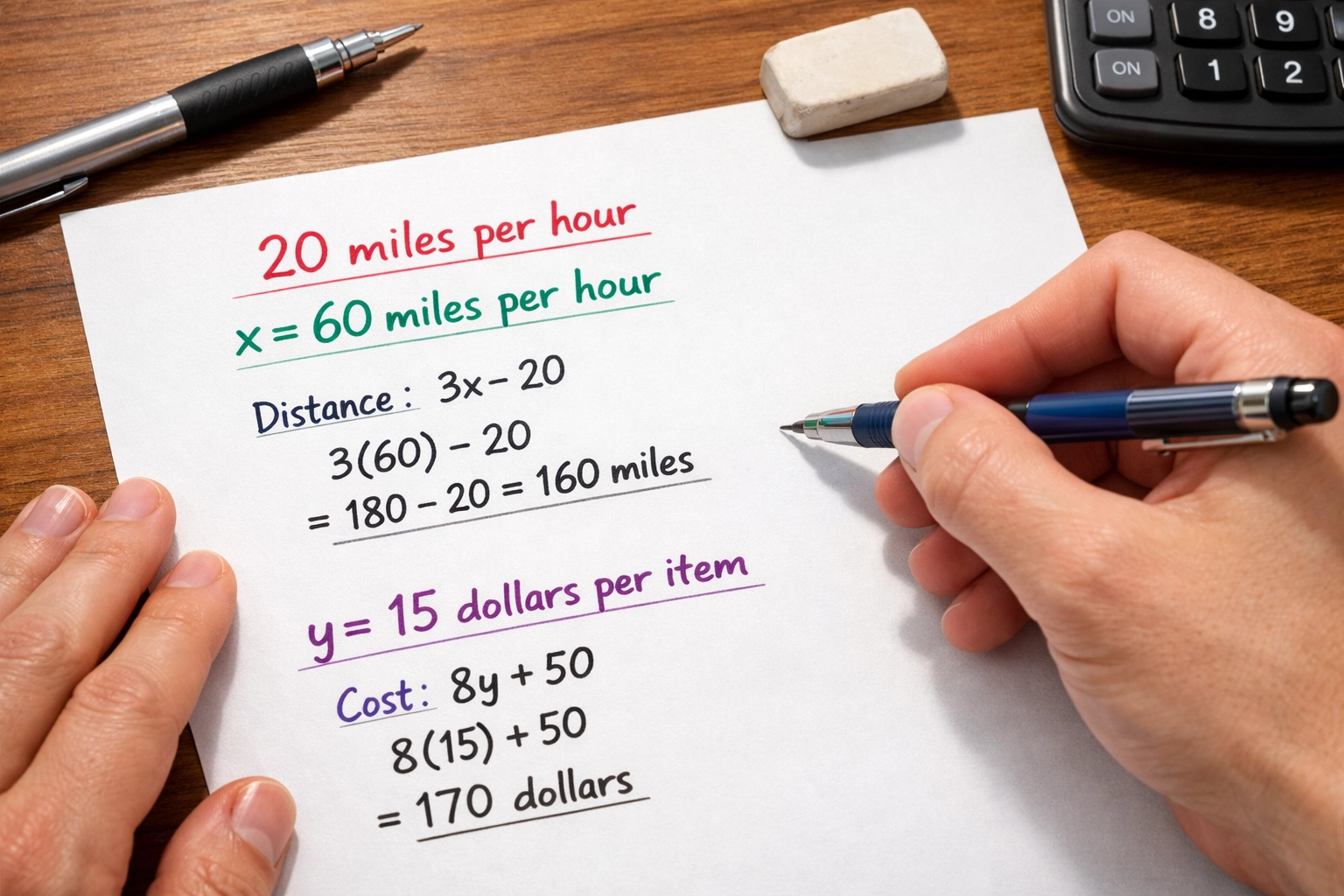
I'm serious. Every single number you write down should have a label attached to it. Not just "20" but "20 students." Not just "$450" but "$450 per week." Not just "3.5" but "3.5 miles per gallon."
Why does this work? Because the SAT deliberately buries units in long paragraphs, hoping you'll lose track. When you label everything, you can't accidentally divide dollars by hours or multiply people by percentages. The math becomes self-checking.
Step-by-Step: The Label Everything Method
- Read the question carefully and identify what you're solving for. Circle it. Underline it. Make it obvious.
- Extract every number from the problem and write it down with its unit. Even if it seems obvious.
- Set up your equation using the labels. If the units don't cancel out correctly, you know you've made a mistake.
- Solve and check your answer against the units. Does your final answer make sense in context?
Let's put this into practice.
Practice: Real SAT Data Questions
Let's work through a classic SAT-style problem based on the 2020 Math Test:
Example 1: Survey Data
A survey of 500 students asked whether they preferred coffee, tea, or neither. 240 students preferred coffee, 180 preferred tea, and the rest preferred neither. If a student is selected at random from those who preferred coffee or tea, what is the probability that the student preferred tea?
Using Label Everything:
- Total students: 500 students
- Coffee: 240 students
- Tea: 180 students
- Neither: 500 - 240 - 180 = 80 students
- Coffee OR Tea: 240 + 180 = 420 students
The question asks for the probability from those who preferred coffee or tea, not from all 500 students. This is where students mess up.
Probability = Tea lovers / (Coffee + Tea lovers)
Probability = 180 / 420 = 3/7
See how labeling every number kept us from dividing by 500 by mistake?
Example 2: Percent Increase
A store increases the price of a jacket from $80 to $100. Later, they offer a 20% discount on the new price. What is the final price of the jacket?
Using Label Everything:
- Original price: $80
- New price: $100
- Increase: $100 - $80 = $20 increase
- Percent increase: ($20 / $80) × 100 = 25% (not asked, but good to know)
- Discount: 20% off $100 = 0.20 × $100 = $20 off
- Final price: $100 - $20 = $80
Wait, the jacket ends up back at the original price? Yep. And that's exactly the kind of twist the SAT loves. If you rushed through without labeling, you might have thought, "25% up, 20% down, so it's $5 more expensive." Wrong.
Example 3: Unit Conversion
A car travels 180 miles in 3 hours. At this rate, how many miles will it travel in 5 hours and 30 minutes?
Using Label Everything:
- Distance: 180 miles
- Time: 3 hours
- Rate: 180 miles / 3 hours = 60 miles per hour
- New time: 5.5 hours (converted 30 minutes to 0.5 hours)
- New distance: 60 miles/hour × 5.5 hours = 330 miles
By labeling "miles per hour" explicitly, you can see exactly how the units cancel out. No confusion, no mistakes.
Tutor Script: Helping Students Navigate Wordy Data Questions
If you're a tutor (or a parent helping your kid study), here's how to guide students through these problems without just giving them the answer.
When a student says: "I don't know where to start."
You say: "Okay, let's find the question first. What are they actually asking us to find? Circle it. Now, let's pull out every number they gave us and label what it represents. What's the first number you see?"
When a student says: "I got a different answer than the choices."
You say: "Let's check your units. When you divided here, what units were you working with? Do they cancel out correctly? Let's trace it step-by-step."
When a student says: "This question is so confusing."
You say: "I get it: they packed a lot of words in there. Let's rewrite it in our own words. If I asked you this question at lunch without all the fancy language, what would it sound like?"
The goal is to teach them to think like the test-writer. The SAT isn't trying to test if you can do calculus. It's testing if you can read carefully, organize information, and avoid careless mistakes under pressure.

Your Next Steps
Module 3 is all about slowing down and staying organized. These questions want you to rush. They want you to skip the labels and dive straight into calculations. Don't give them the satisfaction.
Here's your practice plan for this week:
- Grab 10 data analysis questions from practice tests or Khan Academy.
- Use the Label Everything technique on every single one: even if it feels slow at first.
- Check your work by looking at units. If something doesn't make sense dimensionally, you know you made a mistake.
- Time yourself on the second round. Once you've mastered accuracy, start building speed.
And if you're feeling stuck or want a personalized SAT study plan that targets your specific weak spots, we're here to help. At Light University, we don't just teach you the math: we teach you how to think through these problems like a pro.
You've got this. Now go label everything and show the SAT who's boss. 🎯
Up Next: Module 4 will tackle the Reading section's trickiest question type: Rhetoric and Structure. Stay tuned.