SAT Mastery Series: Writing & Language Deep Dive – Punctuation & Sentence Structure (Module 11)
![[HERO] SAT Mastery Series: Writing & Language Deep Dive – Punctuation & Sentence Structure (Module 11)](https://cdn.marblism.com/h7rc06hTmg8.webp)
You know that sinking feeling when you're staring at a Writing & Language question, and all four answer choices look basically the same except for the punctuation? A semicolon here, a comma there, maybe a dash thrown in for good measure. And you're thinking, "Does it really matter?"
Here's the truth: it absolutely matters. And here's the better truth: once you understand the actual rules behind these punctuation marks, these questions become some of the easiest points you'll score on test day.
Welcome to Module 11 of the SAT Mastery Series. We're diving deep into the punctuation and sentence structure rules that the College Board loves to test: and we're giving you the strategies to master them for good.
Why Punctuation Questions Trip Students Up
Let's be real for a second. Most of us learned punctuation rules in middle school and then... kind of forgot them. We rely on what "sounds right" or what we've seen in text messages and social media posts.
But the SAT isn't testing casual communication. It's testing Standard English Conventions: the formal rules that govern how sentences should be constructed in academic and professional writing.
The good news? There are only a handful of rules you need to know cold. The SAT recycles the same punctuation concepts over and over again. Master the Big Three punctuation marks (semicolons, colons, and dashes), understand independent versus dependent clauses, and you'll unlock at least 5-7 questions per test.
That's potentially 50-70 points. Just from punctuation.
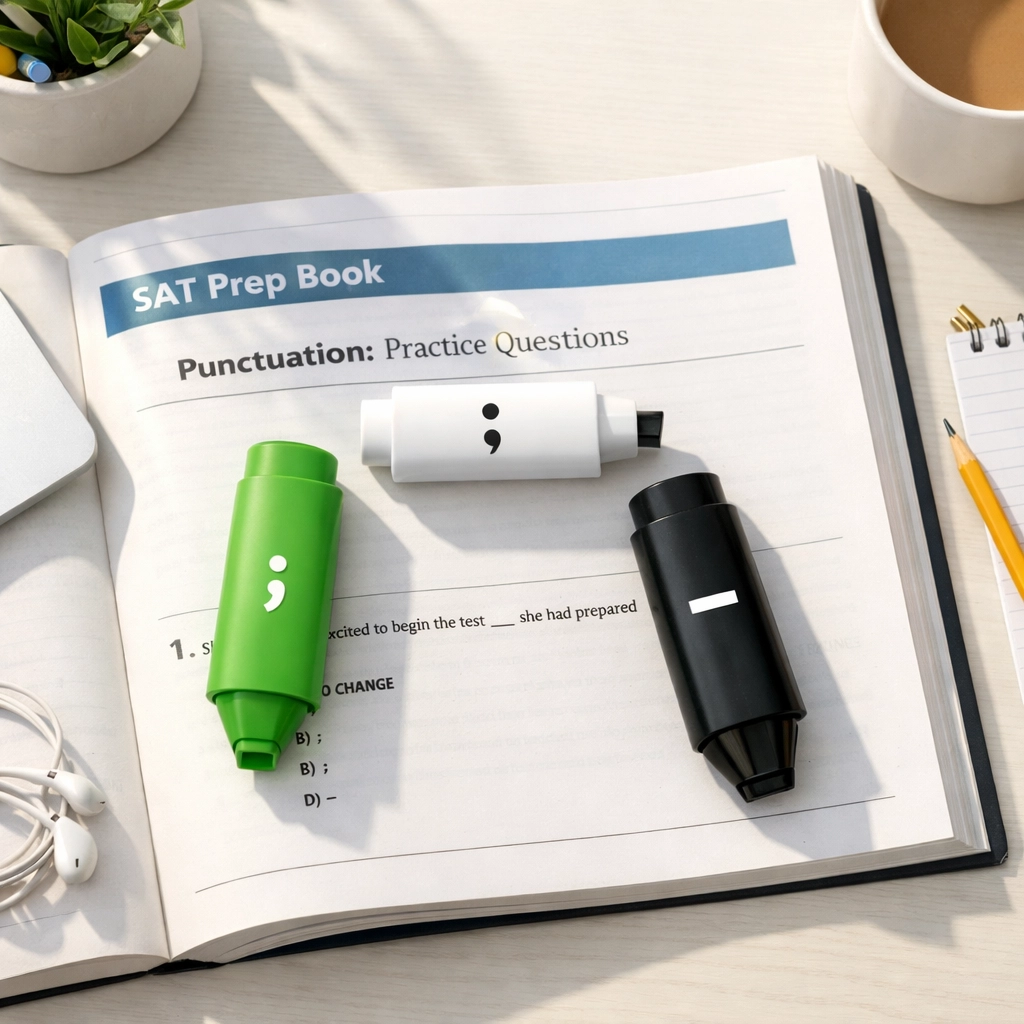
The Big Three: Semicolons, Colons, and Dashes
Let's break down the punctuation marks that cause the most confusion: and the ones the SAT tests most frequently.
Semicolons: The Super Comma
Think of a semicolon as a "super comma": but with one non-negotiable rule: both sides of a semicolon must be complete sentences (independent clauses).
Here's the Period Test strategy: if you can replace the semicolon with a period and both sides would be complete, grammatically correct sentences, then the semicolon works.
Example:
- ✅ The study was comprehensive; it included data from over 10,000 participants.
- ❌ The study was comprehensive; including data from over 10,000 participants.
Why does the second one fail? Because "including data from over 10,000 participants" isn't a complete sentence. It can't stand alone. No semicolon.
Pro tip: Semicolons can also separate items in a complex list where the items themselves contain commas. But honestly? The SAT rarely tests this usage. Focus on the independent clause rule.
Colons: The Introduction Specialist
Colons have one main job: to introduce something. A list, an explanation, an example, or a quotation.
But here's the catch: the part before the colon must be a complete sentence. The part after can be a fragment, a list, whatever: but the setup needs to be a full independent clause.
Example:
- ✅ The researchers made one thing clear: environmental factors played a crucial role.
- ❌ The researchers focused on: temperature, humidity, and altitude.
The second example fails because "The researchers focused on" isn't a complete thought. You need a complete sentence before that colon.
Dashes: The Flexible Friend
Dashes are the most versatile of the Big Three. They can work like colons (introducing information), like commas (setting off non-essential information), or like parentheses (adding extra commentary).
The key rule with dashes? They need to be used in pairs when they're setting off non-essential information in the middle of a sentence.
Example:
- ✅ The experiment: conducted over six months: yielded surprising results.
- ❌ The experiment: conducted over six months, yielded surprising results.
Notice how the first example uses two dashes, creating a clear "interruption" that you could remove and still have a complete sentence? That's the goal. You can't pair a dash with a comma: it has to be dash-to-dash or comma-to-comma.

Independent vs. Dependent Clauses: Your Foundation
Before we go further, you need to understand the difference between independent and dependent clauses. This concept is the foundation for almost every punctuation rule on the SAT.
Independent clause: A complete sentence. It has a subject and verb and expresses a complete thought.
- "The scientist conducted the experiment."
Dependent clause: Has a subject and verb but doesn't express a complete thought. It leaves you hanging, waiting for more information. Usually starts with subordinating conjunctions like "although," "because," "when," "if," "while."
- "Although the scientist conducted the experiment..."
You're left thinking, "Although she conducted the experiment... what? What happened?"
Here's why this matters: independent clauses can be connected with semicolons; dependent clauses cannot. Dependent clauses need commas to attach to independent clauses.
The Non-Essential Clause Strategy
One of the SAT's favorite tricks is testing whether you understand non-essential versus essential information.
Non-essential information can be removed from the sentence without changing the core meaning. It's bonus detail. This gets set off with commas, dashes, or parentheses: but it has to be paired punctuation if it's in the middle of the sentence.
Example:
- ✅ The study, which lasted three years, confirmed the hypothesis.
- ✅ The study: which lasted three years: confirmed the hypothesis.
- ❌ The study, which lasted three years: confirmed the hypothesis.
Essential information is necessary to identify what you're talking about. It doesn't get set off with punctuation at all.
Example:
- ✅ Students who study consistently perform better on standardized tests.
If you removed "who study consistently," the sentence would lose its specific meaning. We're not talking about all students: we're talking about students who study consistently. That's essential. No commas.
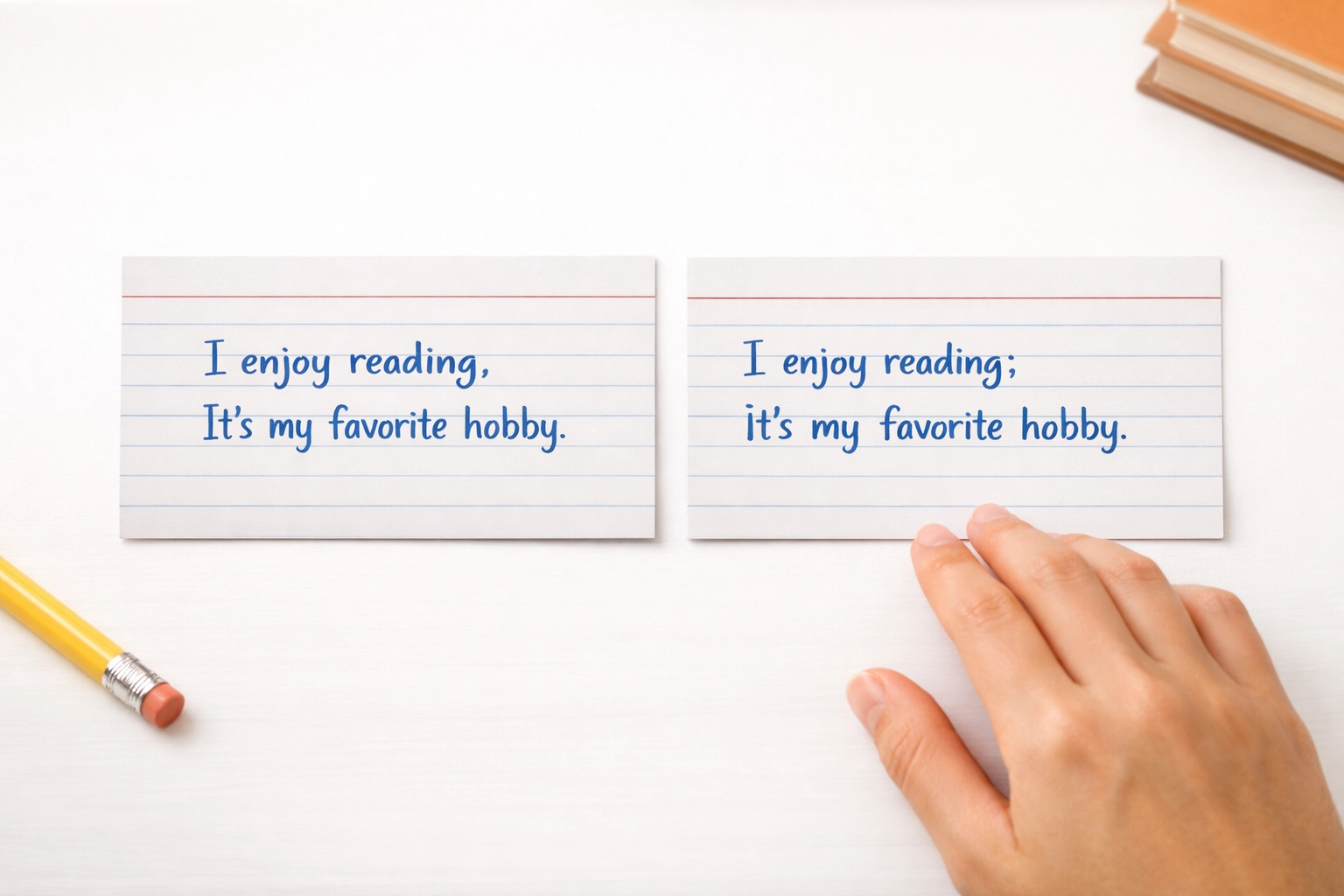
Comma Splices: The Silent Killer
Let's talk about one of the most common errors on the SAT: the comma splice.
A comma splice happens when you try to connect two independent clauses with just a comma. It's not strong enough. You need either a semicolon, a period, or a comma plus a coordinating conjunction (FANBOYS: for, and, nor, but, or, yet, so).
Example:
- ❌ The results were unexpected, the team decided to repeat the experiment.
- ✅ The results were unexpected; the team decided to repeat the experiment.
- ✅ The results were unexpected, so the team decided to repeat the experiment.
- ✅ The results were unexpected. The team decided to repeat the experiment.
Run the Period Test. Both sides are complete sentences, right? Then a lonely comma won't cut it.
Practice Makes Permanent
Here's where the magic happens: you need to see these rules in action, over and over, in SAT-style passages.
In this module, you'll work through 10 carefully designed practice passages that focus specifically on tricky punctuation scenarios. We're talking:
- Semicolons vs. colons in context
- Dash-comma confusion
- Comma splices hiding in complex sentences
- Non-essential clause identification
- Run-on sentence fixes
But here's what makes this different from random practice: 70% of your time should be spent on the explanations, not just answering questions.
Why? Because when you understand why an answer is correct: not just that it is: you're building transferable skills. You're training your brain to recognize patterns. You're becoming the kind of test-taker who can walk into any Writing & Language question with confidence.
The Tutor Scripts: Your Secret Weapon
Every practice question in this module comes with detailed Tutor Scripts. These aren't just answer keys. They're step-by-step walkthroughs that explain:
- Why the correct answer works (with the specific rule referenced)
- Why each wrong answer fails (and which rule it violates)
- The "long way" (checking every rule carefully) versus the "SAT shortcut" (pattern recognition)
Think of these scripts as having a tutor sitting next to you, explaining the thought process behind every single choice. That's how you internalize these rules. That's how punctuation questions become automatic.

Putting It All Together
By the end of this module, you'll have conquered the punctuation demons that haunt most SAT test-takers. You'll know:
✓ When a semicolon is correct (and when it's absolutely wrong)
✓ How to identify the setup for a colon
✓ The proper pairing for dashes setting off non-essential information
✓ How to spot and fix comma splices instantly
✓ The difference between essential and non-essential clauses
✓ How to run the Period Test like a pro
But more importantly, you'll have confidence. You'll stop second-guessing yourself on these questions. You'll see a punctuation question and think, "Easy points."
That confidence? It spreads. It affects your pacing. It reduces test-day anxiety. It creates momentum.
Your Next Steps
Ready to master SAT punctuation once and for all? Dive into the practice passages in this module. Spend time with those Tutor Scripts. Work through the explanations even when you get questions right: sometimes understanding why something works is just as valuable as knowing what doesn't.
And if you want personalized support as you work through this material, book an appointment with one of our SAT specialists. We can identify your specific trouble spots and create a customized plan to turn those weaknesses into strengths.
Punctuation might seem like a small thing. But small things add up to big score improvements. Let's get those points.