SAT Mastery Series: The Power of Evidence (Module 2)
![[HERO] SAT Mastery Series: The Power of Evidence (Module 2)](https://cdn.marblism.com/Ut9vlvh-xoh.webp)
Welcome back to the SAT Mastery Series! If you crushed Module 1 on Heart of Algebra, you're ready for what might be the most game-changing skill on the entire SAT: Command of Evidence.
Here's the truth: most students answer evidence questions backward. They pick an answer first, then scramble to find proof. And that's exactly how the College Board traps you. Those wrong answer choices? They're designed to sound right when you're hunting for justification.
Today, we're flipping the script. You're going to learn the "Evidence First" mindset that top scorers use, and the "Mirror Method" that makes matching quotes to answers feel like second nature. By the end of this module, you'll approach those paired questions (the inference + evidence combo) with total confidence.
Let's dig in.
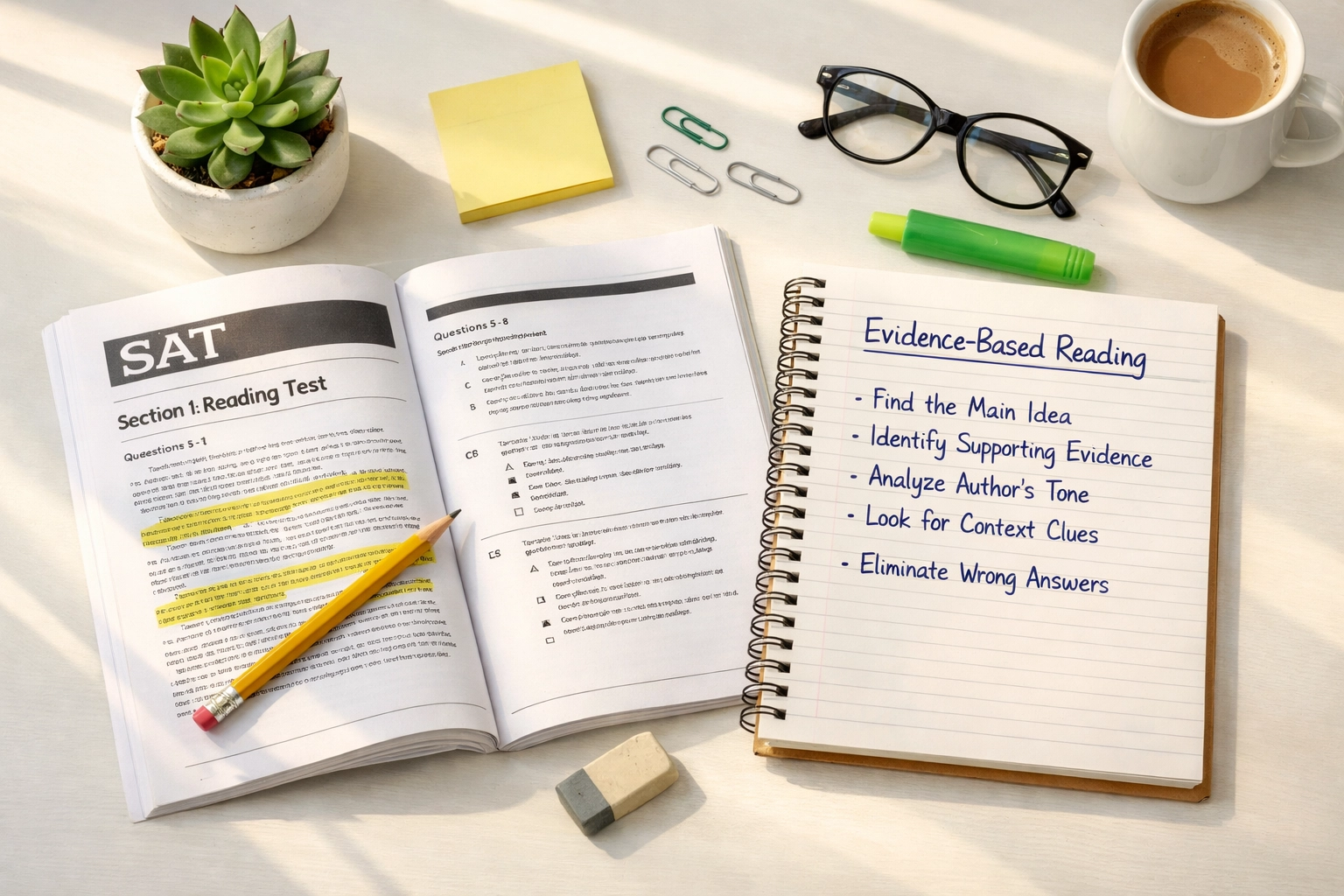
The Problem: Why Evidence Questions Feel Impossible
You've been there. You read a passage about some historical figure or a scientific study. Then comes the question: "Which choice best supports the claim that..." or "The narrator suggests that..."
You pick what feels right. Then you look at the evidence choices in the next question and... none of them seem to match. Or worse, three of them seem plausible.
Sound familiar?
Here's what's happening: The SAT doesn't test whether you understood the passage. It tests whether you can prove your understanding with textual evidence. That's a completely different skill, and one your English teacher probably never explicitly taught you.
The good news? Once you master this, your reading score will jump. Evidence questions make up a huge chunk of the Reading and Writing section, and they're often the difference between a 650 and a 720.
The Theory: Evidence First, Answer Second
Most test prep books tell you to "read carefully" and "find support for your answer." That's not wrong, it's just incomplete.
The real strategy is this: Look at the evidence before you commit to an answer.
Here's why this works:
- The evidence is objective. The quotes are right there in black and white. There's no interpretation needed, you're just matching words.
- Wrong answers reveal themselves. If an answer choice has zero support in the passage, you can eliminate it immediately.
- You stay grounded in the text. This prevents you from importing your own opinions or assumptions into the question.
Think of it like a detective solving a case. You don't decide who the culprit is and then look for clues. You gather the clues first, and the answer reveals itself.
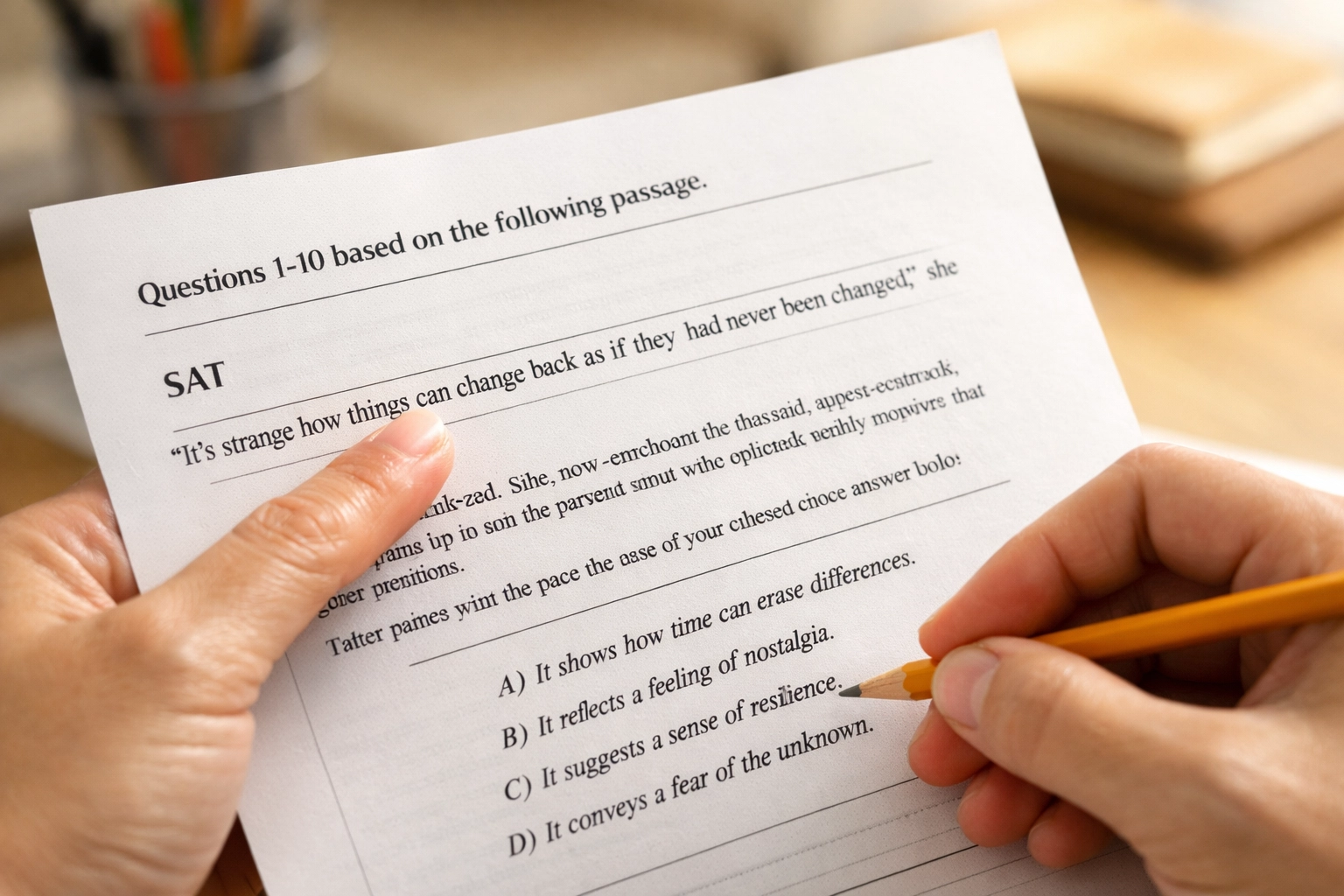
The Strategy: The Mirror Method
Now let's get tactical. I call this the Mirror Method because you're literally holding each piece of evidence up to the answer choices like a mirror: and seeing which one reflects back perfectly.
Step 1: Read the Inference Question (But Don't Answer Yet)
Read the question carefully. Understand what it's asking: but don't pick an answer. Just note the options mentally.
Example: "The narrator's initial opinion of Miss Gracie Spivey is that she is..."
Your brain will want to jump to an answer. Resist. Move to Step 2.
Step 2: Jump to the Evidence Question
This is the move that changes everything. Go straight to the next question: the one that asks, "Which choice provides the best evidence for the answer to the previous question?"
Read all four quote options. These are your mirrors.
Step 3: Test Each Quote Against the Answer Choices
Take each piece of evidence and ask: Which answer choice does this quote directly support?
- Does the quote explicitly say or strongly imply something about the narrator's opinion?
- Does it create a logical link to one specific answer choice?
- Or does it talk about something totally unrelated?
The right evidence will feel like a perfect match: like two puzzle pieces clicking together.
Step 4: Choose the Pair That Makes Sense
Once you've found the evidence that clearly supports one answer, you've found your pair. Circle both answers and move on.
Pro tip: Sometimes you'll eliminate three answer choices on the inference question just because their "evidence" doesn't exist. That's the power of this method.
Practice: Let's Apply the Mirror Method
Let's use a real example from the 2020 SAT Reading Test 1: the passage about Miss Gracie Spivey arriving in Threestep, Georgia to teach at a school during the Great Depression.
Here's the setup:
Question 3 (Inference): Over the course of the passage, the main focus shifts from a discussion of an unusual character to
- A) a description of the narrator's conflicting emotions
- B) an explanation of how the narrator became involved in a complex situation
- C) a contrast between the narrator's expectations and reality
- D) an analysis of the historical context surrounding the narrator's experience
Question 4 (Evidence): Which choice provides the best evidence for the answer to the previous question?
- A) Lines 12-14 ("I heard... Spivey")
- B) Lines 22-25 ("I listened... sense")
- C) Lines 34-37 ("When I... Georgia")
- D) Lines 68-70 ("She said... school")
Let's Mirror It
Test Choice A: The narrator hears about Miss Spivey and forms an image. Does this show a shift in focus? Not really. It's just the beginning of the story.
Test Choice B: The narrator listens as Miss Spivey talks about her travels and starts to piece things together. This shows the narrator becoming involved in understanding who Miss Spivey is: but is it a "complex situation"? Hmm. Keep it as a maybe.
Test Choice C: "When I... Georgia" : This is where the narrator compares what she expected (a normal teacher) with what she got (this worldly, unusual woman). That's a contrast between expectations and reality. This mirrors Answer C from Question 3 perfectly.
Test Choice D: Miss Spivey talks about school. This is just dialogue: doesn't show a shift in focus.
The Answer: Question 3: C and Question 4: C. The passage shifts from introducing Miss Spivey to showing how the narrator's expectations clashed with reality: and the evidence in lines 34-37 directly supports that.
See how the evidence led us to the answer? That's the Mirror Method in action.
Tutor Script: Helping Students Who Struggle
If you're a tutor (or a parent helping your kid), here's how to coach through this:
Problem: "I just don't see it."
Solution: Have them read the evidence quote out loud and then ask: "What is this quote literally saying?" Sometimes students overthink. Bring them back to the plain meaning of the words.
Problem: "Two answers seem right."
Solution: Use the "Which one is more directly stated?" test. The SAT loves answers that are closely paraphrased from the text: not ones that require three steps of logical reasoning.
Problem: "I keep getting evidence questions wrong."
Solution: Practice only paired questions for a week. Use old SAT practice tests and do 10 paired questions per day. The pattern will become muscle memory.
Problem: "I run out of time."
Solution: Remind them that the Mirror Method actually saves time. You're not waffling between answers: you're using the evidence to make a clear decision. Confidence = speed.

Your Action Plan for This Week
Here's your SAT study plan to master Command of Evidence:
Day 1-2: Practice the Mirror Method on 5 paired questions from old SAT tests. Use this exact strategy: no shortcuts.
Day 3-4: Focus on active recall. After you finish a question, close the test and explain why your answer was right using only your memory. This locks in the pattern.
Day 5: Take a full Reading section under timed conditions. Notice how much faster and more confident you feel on evidence questions.
Day 6: Review your mistakes. For every wrong answer, identify where you broke from the Mirror Method.
Day 7: Rest. Let your brain consolidate these test taking strategies.
What's Next?
You've now got the foundational mindset for crushing evidence questions. In Module 3, we're diving into Problem Solving and Data Analysis: where the SAT tries to drown you in charts, percentages, and word problems designed to eat up your time.
Until then, keep practicing the Mirror Method. The more you use it, the more automatic it becomes: and the more points you'll rack up on test day.
Remember: the SAT isn't testing how smart you are. It's testing how to study effectively and apply strategies under pressure. You've got this.
Want personalized help mastering the SAT? Book an appointment with one of our expert tutors at Light University. We'll build a custom study plan that fits your goals: and your schedule.