SAT Mastery Series: The Winner's Edge – Mindset & Final Strategy (Module 7)
![[HERO] SAT Mastery Series: The Winner's Edge – Mindset & Final Strategy (Module 7)](https://cdn.marblism.com/zDfpi3SyZYo.webp)
Welcome to Module 7, the final piece of your SAT preparation puzzle. You've mastered the content. You know the math formulas, the grammar rules, and the reading strategies. But here's the truth: knowing how to answer questions isn't enough if your brain shuts down on test day.
This module isn't about learning more content. It's about building the mental armor you need to stay calm, focused, and strategic when the clock is ticking and your palms are sweating. Let's talk mindset.
The Psychology of Test-Taking: Why Smart Students Freeze
You've probably experienced this: You're cruising through a section, feeling confident, and then you hit a question that makes zero sense. Suddenly, your heart races. You read it three times. Still nothing. Panic creeps in. "What if I'm not ready? What if I fail?"
This is test anxiety, and it's not a character flaw, it's your brain's survival response kicking in at the worst possible time.
Here's what happens: When you feel stressed, your amygdala (the fear center of your brain) floods your system with cortisol. This hormone is great if you're running from a bear, but terrible if you're trying to solve quadratic equations. It literally blocks access to your prefrontal cortex, the part of your brain responsible for logic, reasoning, and problem-solving.
Translation: Anxiety makes you temporarily dumber.
The good news? You can train your brain to stay calm under pressure. Elite athletes do it. Surgeons do it. And you can do it too.

Strategy 1: The 20-Second Rule (Your New Best Friend)
Here's a game-changing principle: If you haven't made meaningful progress on a question within 20 seconds, skip it.
I know what you're thinking: "But I can't just skip questions! I need to get them all right!" Wrong. That perfectionist mindset is exactly what tanks your score.
Why This Works:
- You protect your time for questions you can answer
- You avoid the anxiety spiral that kills momentum
- You return to hard questions with fresh eyes (and often they suddenly make sense)
How to Execute:
- Read the question
- Start working (20 seconds begins NOW)
- If you're stuck or guessing wildly, circle it and move on
- Come back during your last 5 minutes
Pro Tip: Practice this rule during your study sessions. Set a timer. Get comfortable with the feeling of letting go. It's a skill, not a cop-out.
Strategy 2: The Last 5-Minute Panic-Prevention Drill
With 5 minutes left in any section, most students panic. They're frantically bubbling answers, second-guessing themselves, and making careless mistakes.
Here's your new protocol:
STOP. BREATHE. EXECUTE.
The Drill:
- Stop working (yes, really)
- Take 3 deep breaths (4 seconds in, 4 seconds out)
- Scan your answer sheet for blank bubbles
- Return to circled questions and make your best educated guess
- Use process of elimination ruthlessly, even eliminating one wrong answer boosts your odds
This 30-second reset can save you 50+ points. Your brain needs oxygen and clarity, not more panic.
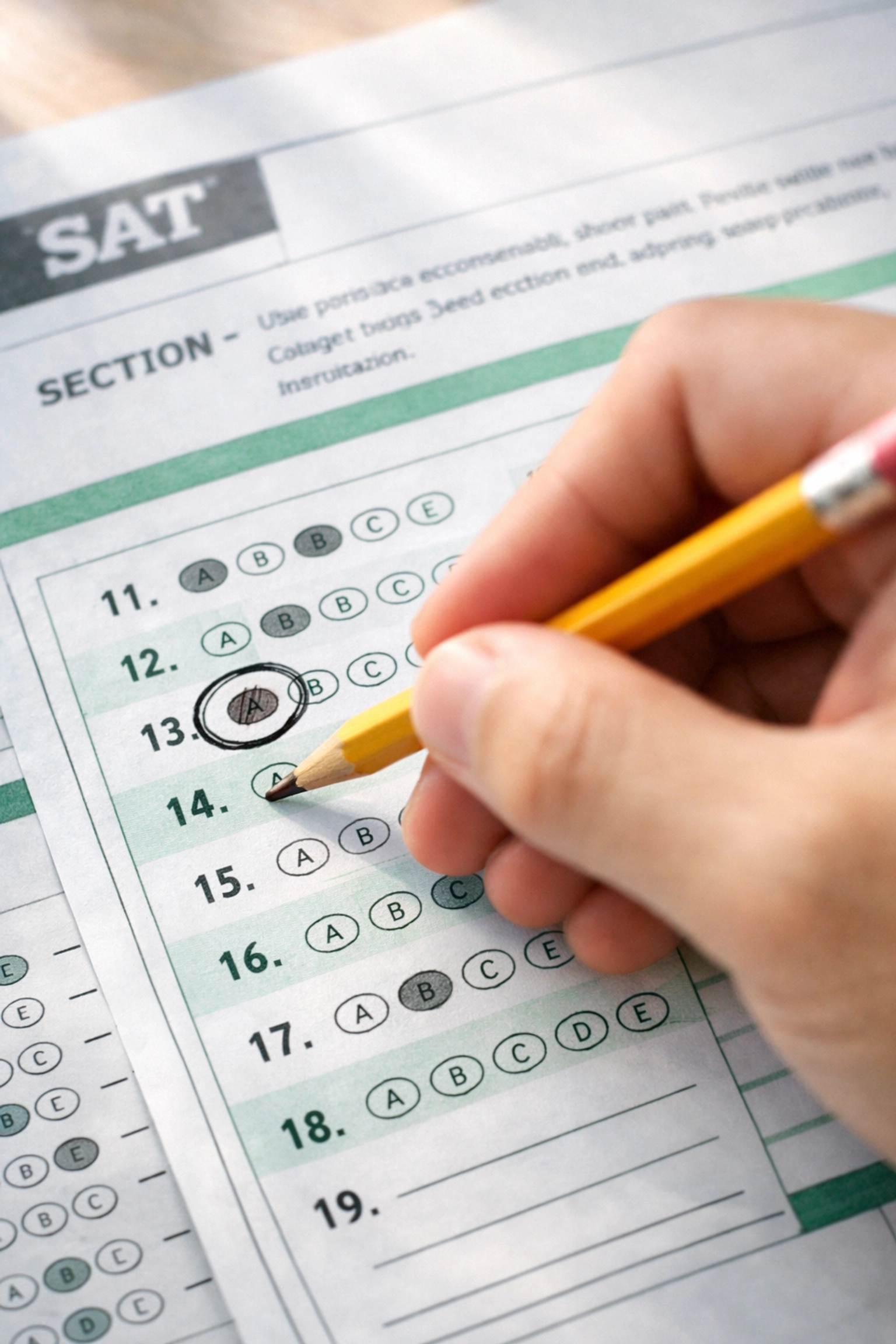
Practice: The Mixed Bag Challenge
Time to put everything together. Below are 6 challenging questions from the 2020 SAT Practice Test 1, 2 Math, 2 Reading, 2 Writing. These aren't easy. They're designed to test your stamina, strategy, and ability to stay calm when things get tough.
For each question, I'm walking you through the complete thought process, not just the answer.
MATH QUESTION 1: Heart of Algebra
Question: If 3(x + 5) = 2(x - 1), what is the value of x?
Step-by-Step Solution:
Distribute both sides:
3x + 15 = 2x - 2Isolate x by subtracting 2x from both sides:
3x - 2x + 15 = -2
x + 15 = -2Subtract 15 from both sides:
x = -17
Answer: x = -17
Tutor Note: Students often rush and make sign errors. Emphasize checking each step, especially when negative numbers appear.
MATH QUESTION 2: Passport to Advanced Math
Question: For i = √-1, what is the value of (3 + 2i)(4 - i)?
Step-by-Step Solution:
Use FOIL (First, Outside, Inside, Last):
First: 3 × 4 = 12
Outside: 3 × (-i) = -3i
Inside: 2i × 4 = 8i
Last: 2i × (-i) = -2i²Combine:
12 - 3i + 8i - 2i²Remember that i² = -1:
-2i² = -2(-1) = 2Simplify:
12 + 2 + (-3i + 8i) = 14 + 5i
Answer: 14 + 5i
Tutor Note: The i² = -1 step trips up students every time. Drill this concept separately if needed.
READING QUESTION 1: Command of Evidence
Question: Which choice provides the best evidence for the previous question's answer about the author's main claim regarding historical preservation?
Context: The passage argues that preserving historical sites requires balancing tourism revenue with conservation efforts.
Step-by-Step Solution:
Re-read the previous question's answer (the main claim you identified)
Scan the passage for explicit statements that directly support that claim
Eliminate choices that:
- Provide examples but not the core argument
- Address a different topic
- Are too vague or general
Look for lines where the author states their position clearly, often with words like "must," "essential," or "requires"
Answer: Lines 34-37 (where the author explicitly states the balance is "essential to long-term success")
Tutor Note: Evidence questions require students to find the proof, not just related content. Teach them to match the evidence to the specific claim.

READING QUESTION 2: Words in Context
Question: As used in line 42, "tempered" most nearly means:
A) Hardened
B) Moderated
C) Strengthened
D) Heated
Step-by-Step Solution:
Re-read the sentence: "The architect's ambitious design was tempered by budget constraints."
Try replacing "tempered" with each answer choice:
- "Hardened by budget constraints" → doesn't make sense
- "Moderated by budget constraints" → makes sense (the design was scaled back)
- "Strengthened by budget constraints" → contradicts the meaning
- "Heated by budget constraints" → irrelevant
Consider context: The design was ambitious, but constraints limited it
Answer: B) Moderated
Tutor Note: Always substitute the answer back into the sentence. If it sounds weird, it's wrong.
WRITING QUESTION 1: Standard English Conventions
Question: The committee has reviewed the proposals and selected three finalists.
A) NO CHANGE
B) have reviewed
C) were reviewing
D) review
Step-by-Step Solution:
Identify the subject: "The committee" (singular collective noun)
Check subject-verb agreement:
Singular subject = singular verb → "has reviewed" is correctEliminate wrong answers:
- "have reviewed" → plural verb (incorrect)
- "were reviewing" → past progressive (doesn't match "selected")
- "review" → present tense (doesn't match completed action)
Answer: A) NO CHANGE
Tutor Note: Collective nouns (committee, team, group) are singular in American English.
WRITING QUESTION 2: Expression of Ideas
Question: Which sentence should be deleted to improve the focus of the paragraph?
Step-by-Step Solution:
Identify the paragraph's main topic (usually stated in the first sentence)
Read each sentence and ask: "Does this directly support or develop the main idea?"
Look for sentences that:
- Introduce new, unrelated topics
- Provide interesting but irrelevant details
- Repeat information already stated
Delete the outlier
Tutor Note: Students overthink this. If a sentence feels like it "doesn't belong," it probably doesn't.
🎯 TUTOR SCRIPT: Coaching Through Mid-Test Burnout
Scenario: Your student is 90 minutes into the SAT. They're exhausted, losing focus, and spiraling: "I'm blanking on everything. I should just guess and give up."
What You Say:
"Hey, look at me. Take a breath. You're not failing: you're just tired, and that's totally normal. Here's what we're going to do:
First, put your pencil down for 10 seconds. Close your eyes. Breathe. Your brain needs a reset.
Second, look at how much you've already crushed. You're three sections in. That's huge.
Third, use the 20-Second Rule we practiced. Don't force the hard ones right now. Circle them, move forward, and protect your momentum.
You've got this. Focus on the next question in front of you: not the whole test. One question at a time."
Why This Works:
You're validating their feelings, breaking the task into manageable pieces, and reminding them of their training. Panic lives in the big picture; confidence lives in the next single step.

Your Mental Playbook: Test Day Essentials
✅ The night before: No cramming. Watch a movie. Sleep 8 hours.
✅ Morning of: Eat protein. Avoid energy drinks (they cause crashes).
✅ During the test: Use the 20-Second Rule religiously.
✅ With 5 minutes left: Execute the Panic-Prevention Drill.
✅ Between sections: Stretch, hydrate, breathe.
The SAT isn't just testing what you know: it's testing whether you can stay calm and strategic under pressure. And now? You're ready.
Ready to level up your SAT game with personalized coaching? Explore our programs or book an appointment with one of our expert tutors today.
You've got the skills. You've got the strategy. Now go show the SAT who's boss. 🚀