SAT Mastery Series: Math Deep Dive – Trigonometry & Geometry Essentials (Module 23)
When Triangles and Circles Team Up Against You
You know that sinking feeling when you flip to the math section and see a weird circle with triangles inside it? Or when a problem casually throws "radians" at you like you're supposed to just know what that means?
Here's the truth: SAT geometry and trigonometry questions aren't testing if you're a math genius. They're testing whether you can recognize patterns, visualize relationships, and apply a handful of essential formulas. The College Board loves these topics because they separate students who memorize blindly from those who actually understand the concepts.
Today, we're going to break down the exact strategies you need to master SAT trigonometry and geometry. No confusing textbook explanations. Just clear, practical approaches that'll have you solving these problems with confidence.
The Foundation: What You Actually Need to Know
SOHCAHTOA – Your New Best Friend
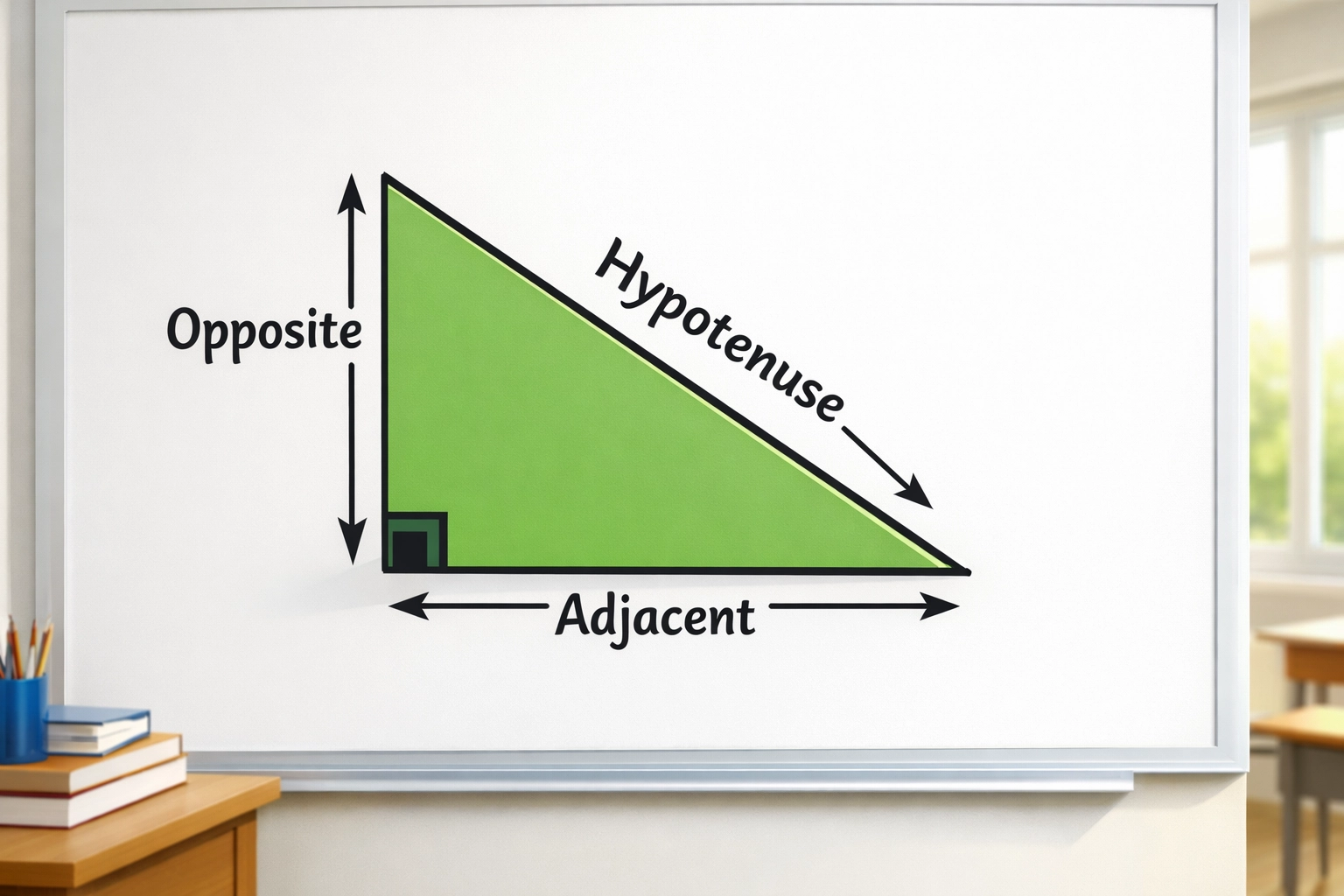
Right-angle trigonometry sounds intimidating, but it's built on three simple ratios. In any right triangle, you have three sides (opposite, adjacent, and hypotenuse) and three trig functions that relate them:
SOH: Sin(θ) = Opposite / Hypotenuse
CAH: Cos(θ) = Adjacent / Hypotenuse
TOA: Tan(θ) = Opposite / Adjacent
The SAT doesn't usually ask you to memorize these, they're often given in the reference sheet. But knowing which one to use? That's where students stumble. Your job is to identify the angle in question, label your sides accordingly, and pick the ratio that connects what you know to what you need.
Degrees vs. Radians: The Conversion You Can't Ignore
Here's where students panic unnecessarily. Radians are just another way to measure angles, and the SAT will occasionally throw them in to see if you're paying attention.
The magic conversion: π radians = 180°
That means:
- To convert degrees to radians: multiply by π/180
- To convert radians to degrees: multiply by 180/π
If you see π/4 radians, that's 45°. If you see 2π/3 radians, that's 120°. Once you convert, these problems become way less scary.
Circle Theorems That Actually Appear on the SAT
The SAT loves circles, especially when combined with triangles or angles. Master these three formulas:
Arc Length: s = rθ (where θ is in radians)
Sector Area: A = (1/2)r²θ (where θ is in radians)
Central Angle: The angle at the center equals twice the inscribed angle
Notice a pattern? When working with arc lengths and sector areas, you must use radians. The SAT will test whether you remember to convert.
Strategy Section: Think Like a Test-Maker
The Complementary Angle Secret Weapon
Here's a relationship that shows up more than you'd expect: sin(x) = cos(90° - x)
Why does this matter? Because the SAT will give you one trig value and ask for another. If you know sin(30°) = 0.5, you automatically know cos(60°) = 0.5. They're testing whether you see the connection.
This works because in a right triangle, the two non-right angles are complementary (they add up to 90°). The side that's "opposite" to one angle is "adjacent" to the other. Mind-blowing, right?
Visualizing Without a Diagram
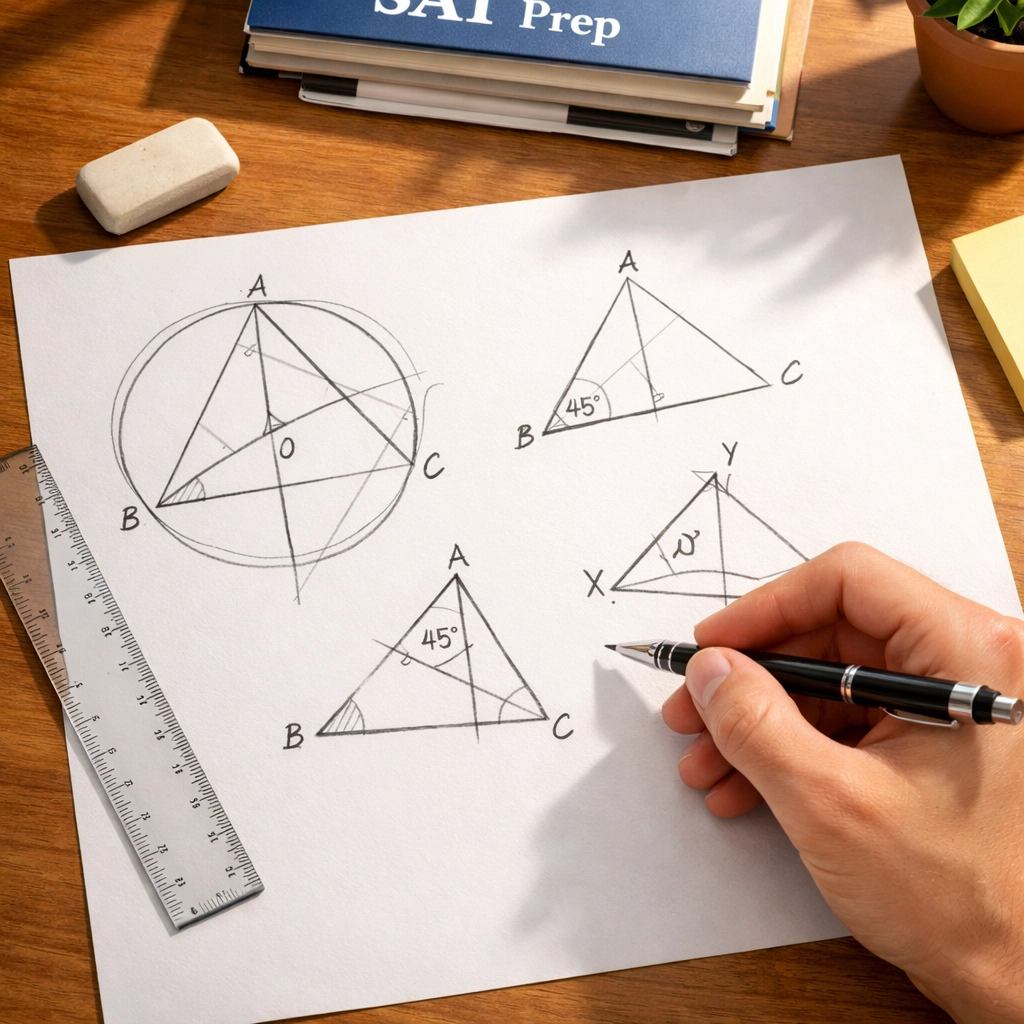
Some of the hardest SAT geometry problems don't give you a picture. This is intentional. They want to see if you can translate words into visual understanding.
Your move: Always sketch it yourself. Even if your drawing looks like it was made by a kindergartener, the act of putting pen to paper forces your brain to process spatial relationships. Label everything. Mark what you know. Draw in those right angles, radii, and parallel lines.
Practice Problems: Let's Get Our Hands Dirty
Problem 1: Basic Trigonometry Setup
Question: In a right triangle, if sin(A) = 3/5 and the hypotenuse is 15, what is the length of the side opposite angle A?
Tutor Script Walkthrough:
Okay, let's break this down together. You're given sin(A) = 3/5, and remember, sine is opposite over hypotenuse. So we can write:
sin(A) = opposite/hypotenuse = 3/5
But wait: they told you the actual hypotenuse is 15, not 5. This means we're dealing with a scaled-up version of the 3-4-5 triangle. Set up a proportion:
3/5 = x/15
Cross-multiply: 5x = 45, so x = 9.
Answer: 9
The key here is recognizing that trig ratios stay constant even when the triangle scales up or down. If the ratio is 3:5, and your hypotenuse is 15 (which is 5 × 3), then your opposite side must be 3 × 3 = 9.
Problem 2: Radians in Action
Question: A circle has a radius of 6. What is the area of a sector with a central angle of π/3 radians?
Tutor Script Walkthrough:
First, let's identify what we're looking for: sector area. The formula is A = (1/2)r²θ, where θ must be in radians. Good news: it already is!
Plug in your values:
- r = 6
- θ = π/3
A = (1/2)(6²)(π/3)
A = (1/2)(36)(π/3)
A = 18π/3
A = 6π
Answer: 6π
Notice how clean the math is when you use radians? That's by design. If they'd given you degrees, you'd need to convert first. Always check your angle units before diving into circle problems.

Problem 3: Complementary Angles Strike
Question: If cos(2x) = sin(40°), what is the value of x?
Tutor Script Walkthrough:
This is testing whether you remember the complementary angle relationship. We know that cos(θ) = sin(90° - θ).
So if cos(2x) = sin(40°), then:
2x = 90° - 40°
2x = 50°
x = 25°
Answer: 25°
The trap here is overthinking it. Students sometimes try to use calculators or advanced identities. But the SAT rewards those who spot the pattern. Cosine of an angle equals sine of its complement. That's it.
Problem 4: Multi-Step Circle Problem
Question: A circle with center O has a radius of 8. Points A and B lie on the circle such that arc AB has a length of 4π. What is the measure of central angle AOB in degrees?
Tutor Script Walkthrough:
This is a multi-step problem that requires you to work backward from arc length. Let's organize what we know:
- Radius (r) = 8
- Arc length (s) = 4π
- We need the central angle in degrees
Step 1: Use the arc length formula to find θ in radians.
s = rθ
4π = 8θ
θ = π/2 radians
Step 2: Convert π/2 radians to degrees.
θ = (π/2) × (180/π)
θ = 90°
Answer: 90°
See how the problem layers concepts? Arc length formula, then radians to degrees conversion. The SAT loves these because one mistake early on cascades through the entire problem.
Problem 5: Inscribed Angle Theorem
Question: In circle O, central angle AOB measures 100°. Point C lies on the circle (not on arc AB). What is the measure of inscribed angle ACB?
Tutor Script Walkthrough:
This tests the inscribed angle theorem: an inscribed angle is half the central angle that subtends the same arc.
Central angle AOB = 100°
Inscribed angle ACB = 100°/2 = 50°
Answer: 50°
The beauty of this theorem is its simplicity. No complex calculations: just remember the 2:1 relationship. If you're ever given one and asked for the other, divide or multiply by 2.
Problem 6: Trigonometry Without a Calculator
Question: If tan(θ) = 4/3 and θ is an acute angle in a right triangle, what is sin(θ)?
Tutor Script Walkthrough:
When you know tangent, you can find the triangle. Remember, tan = opposite/adjacent, so we have:
- Opposite = 4
- Adjacent = 3
But we need sine, which requires the hypotenuse. Use Pythagorean theorem:
c² = 4² + 3²
c² = 16 + 9
c² = 25
c = 5
Now we can find sine: sin(θ) = opposite/hypotenuse = 4/5
Answer: 4/5
This is a classic SAT move: giving you one trig ratio and asking for another. The bridge is always the triangle itself. Construct it, find the missing side, then calculate what they're asking for.
Your Geometry Power-Up Checklist
Before you tackle your next practice test, make sure you can:
✓ Identify which trig ratio (sin, cos, tan) connects the information you have to what you need
✓ Convert between degrees and radians confidently
✓ Recognize complementary angle relationships
✓ Sketch geometry problems even when no diagram is provided
✓ Remember that arc length and sector area formulas require radians
✓ Apply the inscribed angle theorem without hesitation
The Truth About SAT Math Mastery
Here's what separates students who struggle with SAT geometry from those who excel: it's not about memorizing 100 formulas. It's about deeply understanding 10 core concepts and knowing exactly when to apply them.
You're not just learning trigonometry and geometry for test day. You're building spatial reasoning skills that'll serve you in physics, engineering, computer graphics, and countless real-world applications. The SAT is just the beginning.
Ready to put these strategies into action? Check out our complete SAT Mastery Series for more deep dives like this one. And if you're looking for personalized guidance through your SAT journey, we're here to help you discover your strengths and build unshakable confidence.
You've got this. One triangle at a time.