SAT Mastery Series: Math Deep Dive – Ratios, Rates, and Percentages (Module 19)
You know that sinking feeling when you see a percentage problem with multiple steps? Or when a rate question asks you to convert units three different times? Yeah, we've all been there. Here's the truth: ratios, rates, and percentages aren't actually hard, they're just tricky. And the SAT loves to make them as confusing as possible.
But here's the good news. Once you master the underlying patterns and learn a few power strategies, these questions become some of the easiest points you'll score on test day. Let's break it all down together.
Understanding the Core: Ratios, Rates, and Percentages
Ratios are just comparisons. If there are 3 cats for every 2 dogs, that's a 3:2 ratio. Simple, right? The key is understanding that ratios tell you about relative quantities, not absolute ones. You might have 6 cats and 4 dogs, or 30 cats and 20 dogs, the ratio stays the same.
Rates are ratios with different units. Miles per hour, dollars per pound, problems per minute, these are all rates. The SAT loves to mix these up with unit conversions to test whether you're paying attention.
Percentages are special ratios out of 100. When something increases by 25%, you're really saying it becomes 125% of its original value. When it decreases by 30%, it becomes 70% of the original. This shift in perspective changes everything.

The Multiplier Strategy: Your New Best Friend
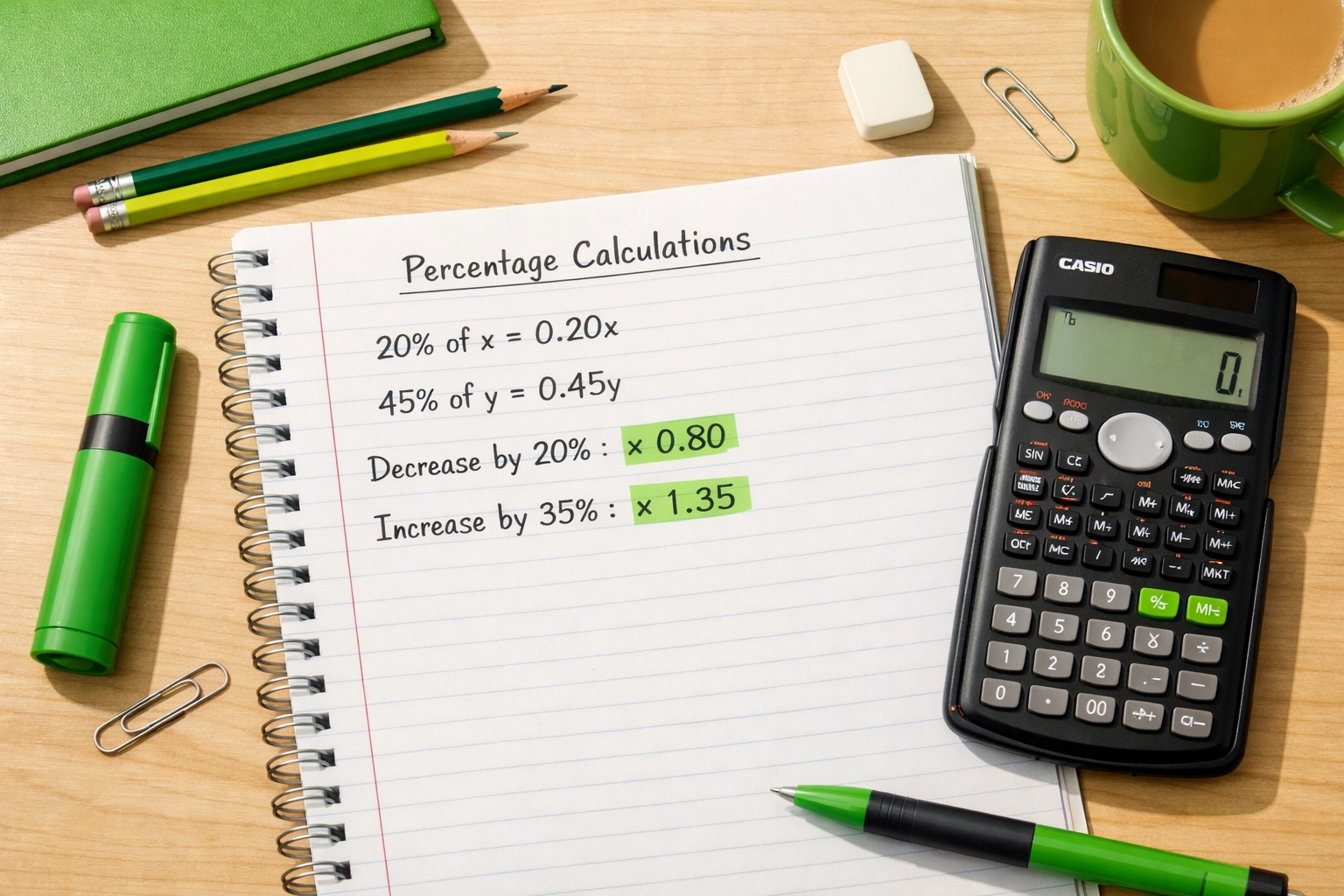
Here's a game-changer that'll save you tons of time. Instead of calculating percentage changes in multiple steps, use multipliers.
Want to decrease something by 20%? Don't subtract 20%, just multiply by 0.80. Want to increase by 35%? Multiply by 1.35. It's that simple.
Let's see this in action. If a $60 shirt goes on sale for 25% off, most students do this:
- Find 25% of 60 = 15
- Subtract: 60 - 15 = 45
But you can just multiply: 60 × 0.75 = $45. One step. Done.
The real magic happens with multi-step percentage changes. If that shirt's price then increases by 20%, you just multiply again: 45 × 1.20 = $54. No messy intermediate calculations.
Units Matching: The Secret to Complex Rate Problems
The SAT will try to trip you up by giving you information in different units. Your job? Make everything match before you calculate.
Here's the technique: write out the units like fractions and cancel them until you get what you want. If you need miles per hour but have feet per second, set up your conversion factors so the unwanted units cancel out.
Practice Problems: Let's Get to Work
Ready to test your skills? Here are SAT-style problems that'll challenge you, but remember, we're walking through every single one together.
Problem 1: Basic Ratio Setup
The ratio of students to teachers at Light University is 15:2. If there are 450 students, how many teachers are there?
Tutor Script: Okay, let's think through this logically. We have a ratio of 15:2, which means for every 15 students, there are 2 teachers. Set up a proportion: 15/2 = 450/x. Cross-multiply: 15x = 900. Divide both sides by 15: x = 60 teachers. The key here is recognizing that ratios scale proportionally. You could also think of it as: 450 ÷ 15 = 30 groups of students, so 30 × 2 = 60 teachers.
Problem 2: Percentage Increase
A laptop costs $800. The price increases by 15%, then decreases by 15%. What is the final price?
Tutor Script: Here's where students mess up: they think the increases and decreases cancel out. They don't! Let's use multipliers. First increase: 800 × 1.15 = $920. Now decrease by 15%: 920 × 0.85 = $782. The final price is $782, which is less than the original $800. Why? Because you're taking 15% of a larger number in the second step. This is a classic SAT trap: always calculate multi-step percentages sequentially.
Problem 3: Rate with Unit Conversion
A car travels at 60 miles per hour. How many feet does it travel in 10 seconds? (1 mile = 5,280 feet)
Tutor Script: This one looks intimidating, but let's use units matching. We need feet per second, but we have miles per hour. First, convert 60 miles/hour to feet/hour: 60 × 5,280 = 316,800 feet/hour. Now convert to feet per second: 316,800 ÷ 3,600 seconds = 88 feet/second. Finally, multiply by 10 seconds: 88 × 10 = 880 feet. The trick is setting up your conversions carefully and canceling units as you go.

Problem 4: Complex Percentage Change
A store marks up a product by 40%, then offers a 25% discount during a sale. If the sale price is $84, what was the original price?
Tutor Script: Now we're working backwards, which is trickier. Let the original price be x. After a 40% markup: x × 1.40. After a 25% discount on that: (x × 1.40) × 0.75 = 84. Simplify: x × 1.05 = 84. Therefore, x = 84 ÷ 1.05 = $80. The key insight? A 40% markup followed by a 25% discount is the same as multiplying by 1.40 × 0.75 = 1.05. Always combine your multipliers when working backwards!
Problem 5: Ratio with Scaling
A recipe calls for flour and sugar in a ratio of 5:3. If you use 2.5 cups of flour, how much sugar do you need?
Tutor Script: Set up your proportion: 5/3 = 2.5/x. Cross-multiply: 5x = 7.5. Solve: x = 1.5 cups of sugar. Alternatively, notice that 2.5 is half of 5, so you need half of 3, which is 1.5. Both methods work: use whichever clicks for you. The SAT rewards flexible thinking.
Problem 6: Triple Percentage Change
An investment of $1,000 grows by 20% in year one, decreases by 10% in year two, then grows by 15% in year three. What is its final value?
Tutor Script: This is where multipliers shine. Year one: 1,000 × 1.20 = 1,200. Year two: 1,200 × 0.90 = 1,080. Year three: 1,080 × 1.15 = 1,242. Final value: $1,242. You could also do this in one step: 1,000 × 1.20 × 0.90 × 1.15 = $1,242. The order doesn't matter when you're multiplying: use this to your advantage and chain calculations together.
Problem 7: Rate Comparison
Machine A produces 150 widgets in 5 hours. Machine B produces 200 widgets in 8 hours. Which machine has a higher production rate?
Tutor Script: Calculate unit rates. Machine A: 150 ÷ 5 = 30 widgets/hour. Machine B: 200 ÷ 8 = 25 widgets/hour. Machine A is faster. Always reduce rates to "per one unit" for easy comparison. Don't be fooled by larger total numbers: the SAT wants to see if you understand rates versus total quantities.
Problem 8: Compound Unit Conversion
A runner maintains a pace of 8 minutes per mile. How many miles does she run in 2 hours and 40 minutes?
Tutor Script: First, convert everything to the same unit. 2 hours and 40 minutes = 160 minutes total. She runs 1 mile every 8 minutes, so: 160 ÷ 8 = 20 miles. The key is recognizing that "8 minutes per mile" means you need to divide total time by 8 to find total miles. Flip the rate concept if needed: miles/minute or minutes/mile, depending on what you're solving for.

Problem 9: Percentage of a Percentage
A population of 50,000 decreases by 20%, then the new population decreases by another 25%. What is the final population?
Tutor Script: Let's use our multiplier method. First decrease: 50,000 × 0.80 = 40,000. Second decrease: 40,000 × 0.75 = 30,000. Final population: 30,000. Notice that the combined effect (50,000 to 30,000) is a 40% decrease overall, not 45%. You're taking 25% of the already-reduced population, not the original. This distinction is crucial.
Problem 10: Complex Ratio Problem
A mixture contains water and juice in a 7:3 ratio. If 5 liters of water are added, the new ratio becomes 3:1. How much water was originally in the mixture?
Tutor Script: Let the original amount of water be 7x and juice be 3x. After adding 5 liters of water: (7x + 5)/3x = 3/1. Cross-multiply: 7x + 5 = 9x. Solve: 5 = 2x, so x = 2.5. Original water: 7 × 2.5 = 17.5 liters. This is a multi-step problem that tests whether you can set up equations from ratio relationships. Take your time, define your variables clearly, and the algebra becomes straightforward.
Your Path Forward
You've just worked through ten challenging problems that cover every type of ratio, rate, and percentage question you'll see on the SAT. The patterns are clear now, right? Set up proportions carefully. Use multipliers for speed. Match your units before calculating. Work sequentially through multi-step problems.
These aren't just math tricks: they're thinking tools that'll serve you in college and beyond. Every time you compare prices, calculate tips, or analyze data, you're using these exact skills.
Want to keep building your SAT math confidence? Check out our Heart of Algebra module or explore Advanced Math concepts next. You're not just preparing for a test: you're building a foundation for academic success.
Keep practicing. Stay curious. You've got this.