SAT Mastery Series: Math Deep Dive – Quadratics & Nonlinear Equations (Module 21)
You know that sinking feeling when you see a quadratic equation on your SAT and your mind goes completely blank? You're not alone. Quadratics trip up more students than almost any other math topic: but here's the truth: they're actually one of the most predictable topics on the test.
Welcome to Module 21 of our SAT Mastery Series. Today, we're transforming quadratics from your nemesis into your secret weapon. Let's dive in.
The Three Faces of Quadratics: Why Form Matters
Every quadratic equation is like a story told three different ways. Understanding which "version" you're looking at unlocks everything.
Standard Form: ax² + bx + c = 0
This is the classic. You'll see it everywhere. But here's what most students miss: the coefficients aren't random numbers: they're telling you a story. The 'a' value controls whether your parabola opens up (positive) or down (negative). The 'c' value? That's your y-intercept, pure and simple.
Vertex Form: a(x - h)² + k = 0
This is your shortcut to understanding the graph's behavior. The (h, k) coordinates give you the vertex instantly. No calculations needed. When you see this form, you're literally reading the parabola's turning point right off the page.
Here's the tutor script you need to internalize: "If I have y = 2(x - 3)² + 5, my vertex is at (3, 5). Not (-3, 5). Why? Because that minus sign in the formula means the opposite of what you see. That mental flip is worth 20+ points on test day."
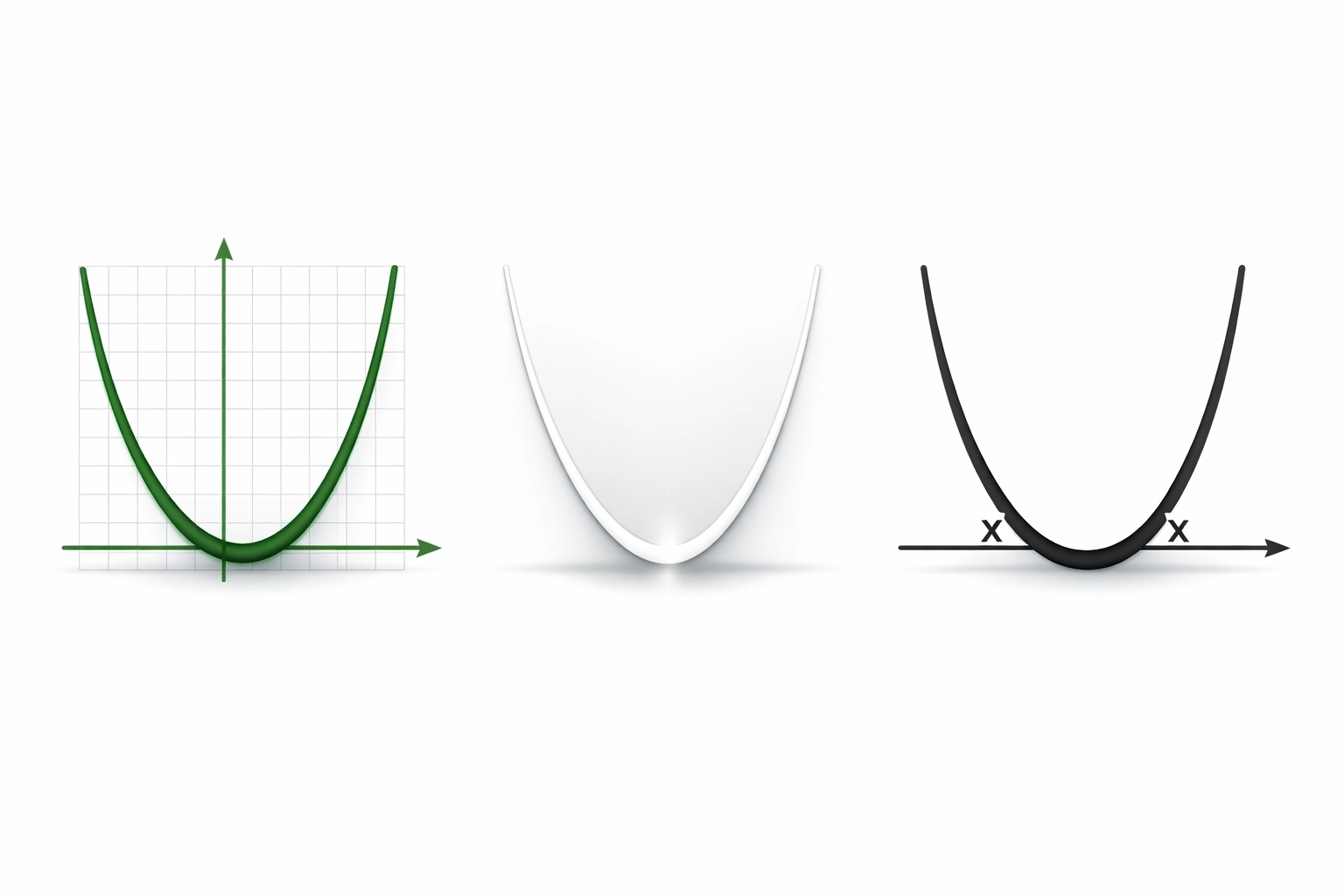
Factored Form: a(x - r₁)(x - r₂) = 0
This form hands you the x-intercepts on a silver platter. Those r₁ and r₂ values? They're where your parabola crosses the x-axis. Master this form and you'll blow through graph analysis questions in seconds instead of minutes.
The Discriminant: Your Crystal Ball
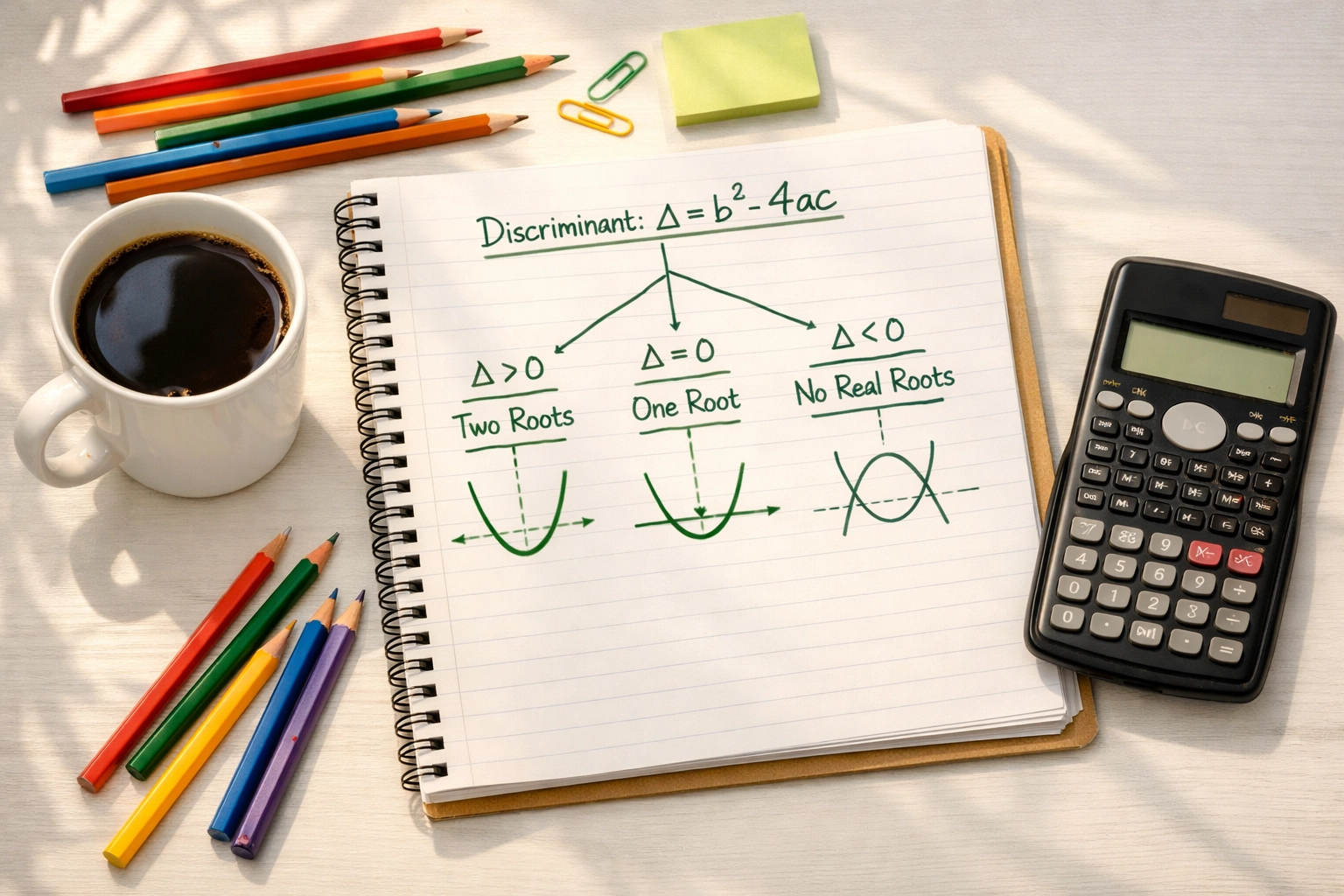
The discriminant (b² - 4ac) is one of the most powerful tools you're probably not using. Here's why it matters:
- Positive discriminant: Two distinct real roots. Your parabola crosses the x-axis twice.
- Zero discriminant: One repeated root. Your parabola just touches the x-axis at its vertex.
- Negative discriminant: No real roots. Your parabola never touches the x-axis.
The SAT loves testing this. They'll give you a quadratic with an unknown constant and ask: "For which value of k does the equation have exactly one solution?" Now you know: set that discriminant equal to zero and solve.
Tutor Script: "Don't memorize this as an abstract formula. Picture it: a positive discriminant means your parabola dips down and crosses twice. A negative one means it floats above the x-axis like a smile that never quite reaches down. That visual will stick with you when formulas fade under pressure."
Strategy: Choosing Your Weapon
The SAT doesn't care how you solve quadratics: they care that you choose the fastest method. Here's your decision tree:
Use Factoring When: The numbers are clean and you can spot factors quickly. If you see x² + 7x + 12 = 0, factor it to (x + 3)(x + 4) = 0. Done in 10 seconds.
Use the Quadratic Formula When: Factoring looks messy or impossible. The formula x = [-b ± √(b² - 4ac)] / 2a works every single time, but it takes longer. Save it for when you need the guarantee.
Use Completing the Square When: They explicitly ask for vertex form or you're working with a word problem about maximums and minimums. It's not the fastest method, but sometimes the question demands it.
The Sum and Product Shortcut: Here's a game-changer most tutors don't teach. For any quadratic ax² + bx + c = 0 with roots r₁ and r₂:
- Sum of roots: r₁ + r₂ = -b/a
- Product of roots: r₁ × r₂ = c/a
The SAT will ask: "If one root is 5, what's the other root?" Instead of solving the whole equation, just use these relationships. Lightning fast.
Practice: High-Frequency SAT Scenarios
Let's walk through the exact question types you'll face.
Problem 1: The Vertex Shift
A parabola has vertex form y = (x - 4)² + 2. If the graph shifts 3 units left and 5 units down, what's the new equation?
Tutor Walkthrough: "Don't overthink this. Left and right shifts affect the x-term. Left means add to what's inside the parentheses. Down means subtract from the outside. New equation: y = (x - 4 + 3)² + 2 - 5, which simplifies to y = (x - 1)² - 3. See? The 'opposite' rule strikes again."
Problem 2: The Discriminant Detective
For the equation 2x² - 5x + k = 0 to have no real solutions, which inequality must k satisfy?
Tutor Walkthrough: "No real solutions means negative discriminant. Set up: b² - 4ac < 0. That's (-5)² - 4(2)(k) < 0. Simplify: 25 - 8k < 0, so 25 < 8k, meaning k > 25/8 or k > 3.125. The SAT loves fractions, so they'd probably say k > 25/8."

Problem 3: The Constant Hunt
If x² + 6x + c = 0 has roots that differ by 4, find c.
Tutor Walkthrough: "This is where sum and product shine. Sum of roots: r₁ + r₂ = -6/1 = -6. We're told r₁ - r₂ = 4. Now you have two equations, two unknowns. Add them: 2r₁ = -2, so r₁ = -1. Then r₂ = -5. Product of roots: (-1)(-5) = 5 = c/1. Therefore, c = 5. Did we use the quadratic formula? Nope. Way faster."
Problem 4: Word Problem Mastery
A ball is thrown upward with height h(t) = -16t² + 64t + 5, where t is time in seconds. What's the maximum height?
Tutor Walkthrough: "Maximum height = vertex. You could complete the square, but here's the shortcut: the x-coordinate of the vertex is -b/2a. That's -64/2(-16) = 2 seconds. Plug that back: h(2) = -16(4) + 64(2) + 5 = -64 + 128 + 5 = 69 feet. Maximum height: 69 feet. The SAT always gives you round numbers in the answer when you've done it right. If you got 69.37, recheck your work."
Problem 5: The System Challenge
At how many points does y = x² - 4x + 3 intersect with y = -x + 3?
Tutor Walkthrough: "Set them equal: x² - 4x + 3 = -x + 3. Simplify: x² - 3x = 0. Factor: x(x - 3) = 0. Two solutions: x = 0 and x = 3. Two solutions means two intersection points. Notice we didn't even find the y-values: the question only asked how many points."
Problem 6: Factored Form Analysis
The equation y = -2(x + 1)(x - 5) represents a parabola. What's the axis of symmetry?
Tutor Walkthrough: "The roots are x = -1 and x = 5. The axis of symmetry runs right down the middle of those roots. Average them: (-1 + 5)/2 = 2. The axis is x = 2. One second. One point. That's the power of understanding what the form is telling you."

Problem 7: The Graph Reader
A parabola opens downward and has x-intercepts at x = 2 and x = 8. Which equation could represent this parabola?
- A) y = (x - 2)(x - 8)
- B) y = -(x - 2)(x - 8)
- C) y = (x + 2)(x + 8)
- D) y = -(x + 2)(x + 8)
Tutor Walkthrough: "Opens downward means negative leading coefficient: eliminate A and C immediately. X-intercepts at 2 and 8 means factors of (x - 2) and (x - 8). Answer: B. You just answered that in under 5 seconds by understanding form."
Problem 8: The Constant with Constraints
If the equation x² + kx + 16 = 0 has exactly one real solution, what's the positive value of k?
Tutor Walkthrough: "One solution means discriminant equals zero. k² - 4(1)(16) = 0. So k² = 64, meaning k = ±8. They asked for positive value: k = 8. The College Board will always specify 'positive' or 'negative' when there are two possible answers."
Your Quadratic Mindset Shift
Here's what separates students who master quadratics from those who struggle: confidence in pattern recognition. Every quadratic question is a variation on these core themes. Once you've walked through these eight scenarios with intention, you've essentially seen 80% of what the SAT can throw at you.
The next time you see a parabola, don't panic. Ask yourself: What form is this? What is it telling me immediately? What's the fastest path to the answer?
This is how you transform test anxiety into test domination. Master the forms. Trust the discriminant. Choose your strategy wisely. And remember: quadratics aren't your enemy. They're your opportunity to shine.
Ready to keep building your SAT math arsenal? Check out our previous modules on Heart of Algebra and Circles and Angles to round out your skills.
You've got this. Let's make those quadratics work for you.