SAT Mastery Series: Reading Deep Dive – Evidence & Supporting Details (Module 16)
You've probably been there. You read an SAT passage, select what feels like the "right" answer, and then: boom: you get it wrong. The explanation says you picked an answer that "wasn't supported by the text." But here's the thing: you felt like it was supported. That's the trap.
Command of Evidence questions are where the SAT Reading section gets ruthless. These questions don't care about what sounds good or what makes logical sense in the real world. They only care about one thing: what's actually written in the passage. If you can't point to the exact lines that prove your answer, you're guessing: and the SAT punishes guessing.
This module is your game-changer. You're going to learn the Golden Rule that elite test-takers swear by, master a reverse-engineering strategy that saves time, and practice with real-style questions until finding evidence becomes second nature.
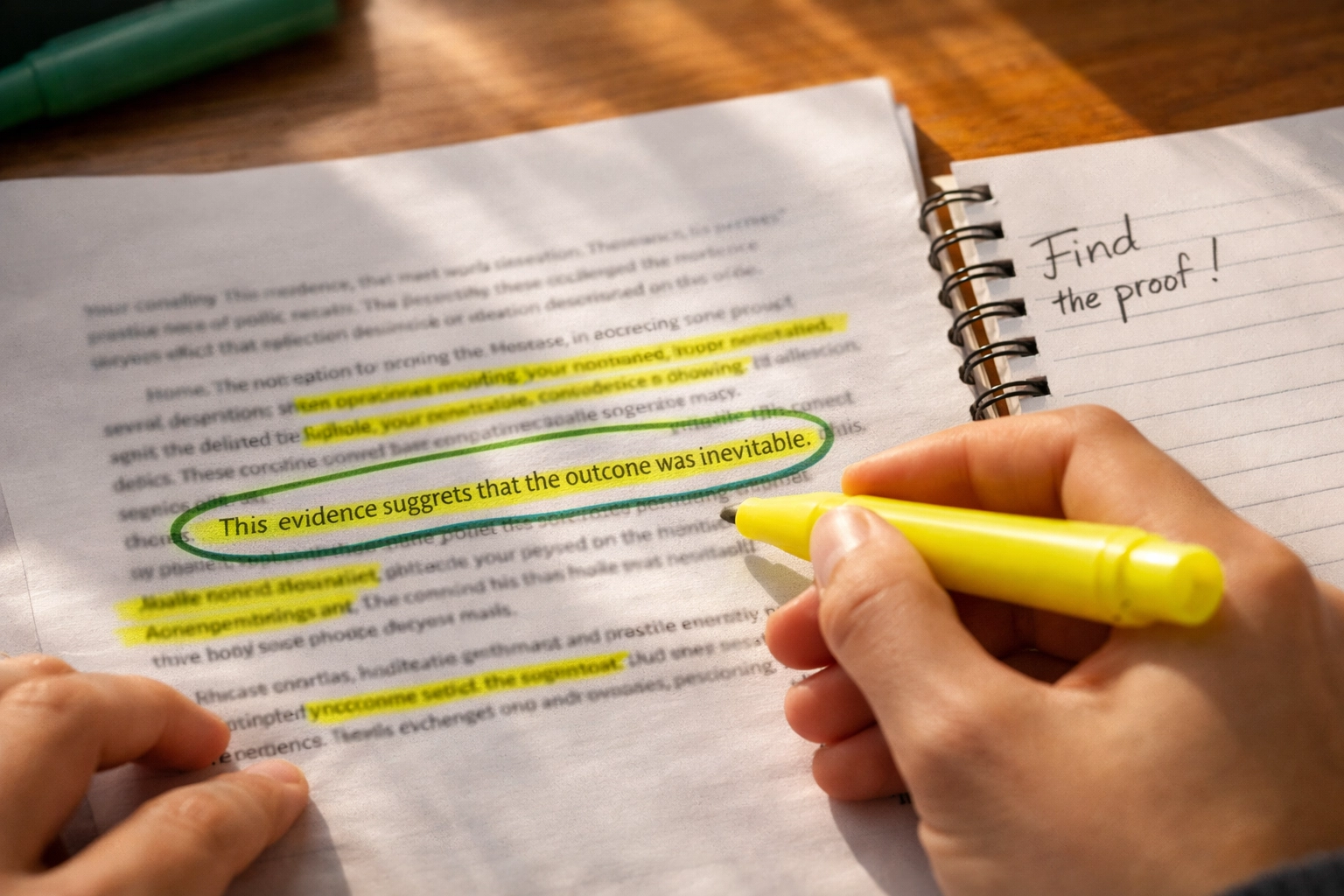
The Golden Rule: "If It's Not in the Text, It's Wrong"
Let's start with the most important principle you'll ever learn for SAT Reading:
If the passage doesn't explicitly say it or directly imply it with zero logical leaps: it's wrong.
This sounds simple, but it's hard to follow in practice. Why? Because your brain is wired to make inferences, connections, and assumptions. That's great for real life. It's terrible for the SAT.
Here's an example. Imagine a passage says: "Maria spent three hours at the library every day after school."
Question: What can we infer about Maria?
Tempting (but WRONG) answer: Maria is a hardworking student who values education.
Correct answer: Maria regularly visited the library after school.
See the difference? The first answer sounds right. It's probably even true. But the passage never says Maria is hardworking or that she values education. It only tells us she went to the library. For all we know, she could've been meeting friends, using the Wi-Fi, or avoiding going home. The SAT doesn't care about what's likely: it cares about what's stated.
This is the mindset shift you need. Every answer must be directly traceable to specific words in the passage. If you're adding outside logic, you're already off track.
Best Evidence Question Pairs: The SAT's Favorite Trick
Command of Evidence questions often come in pairs:
Question 1: Which statement is best supported by the passage?
Question 2: Which lines provide the best evidence for the answer to Question 1?
This pairing is both a gift and a curse. The curse? You have to get both right, or you lose points on both. The gift? You can use them to check each other.
Here's where most students mess up: they answer Question 1 first, then hunt for evidence in Question 2. That's backward: and it wastes time.
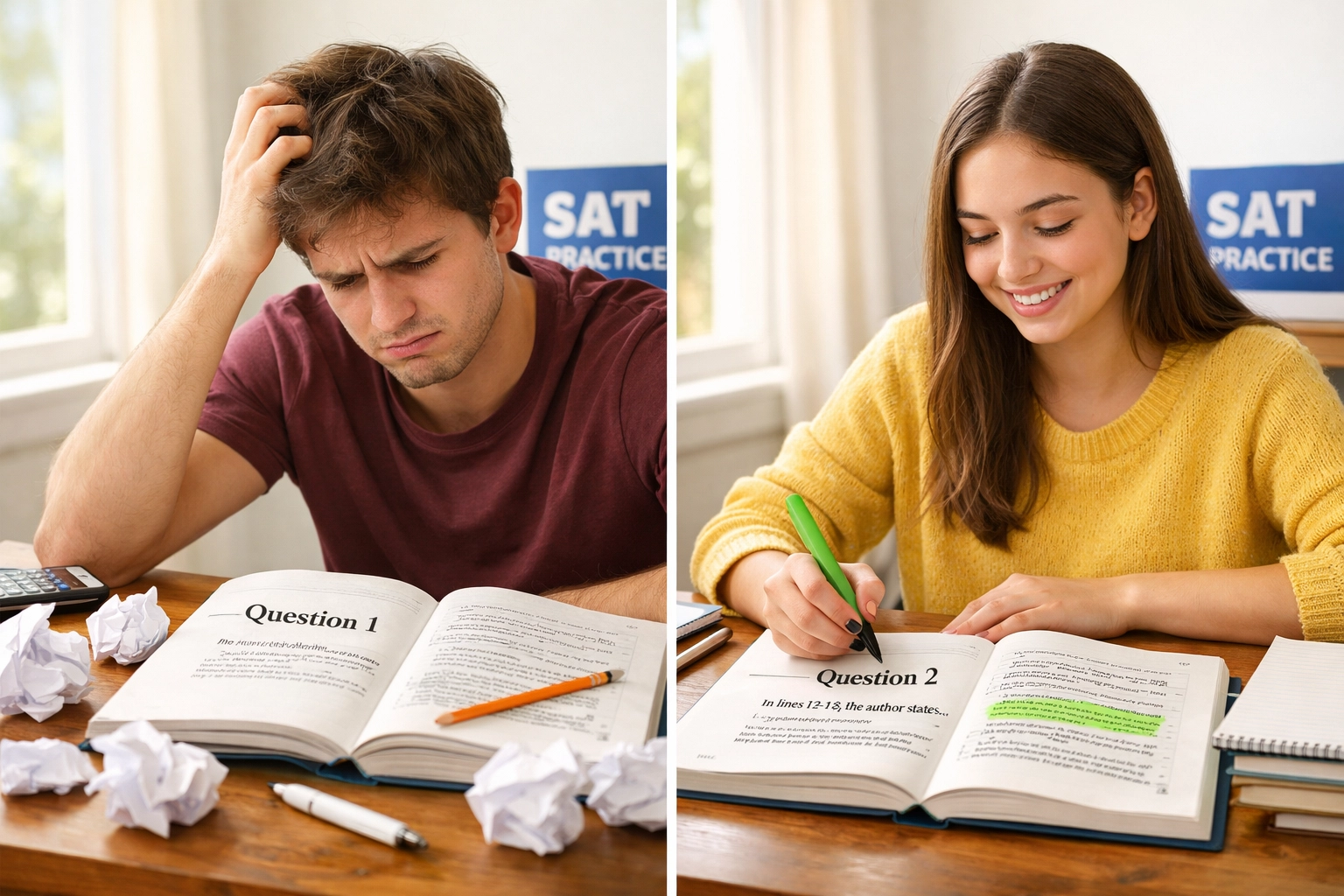
The Reverse Method: Work Smarter, Not Harder
Want to know how top scorers attack these paired questions? They work in reverse.
Instead of choosing an answer for Question 1 and then looking for proof, start with Question 2. Read each line citation option and ask: "What claim does this line support?"
Then match it to Question 1's answer choices.
Why does this work? Because the SAT gives you four specific line references in Question 2. You don't have to search the entire passage: just check those four spots. This narrows your focus and eliminates guesswork.
The Reverse Method in Action
Let's walk through an example.
Passage excerpt:
"The invention of the printing press in the 15th century revolutionized the spread of information. Before Gutenberg's innovation, books were copied by hand, a labor-intensive process that made them expensive and rare. With printed books, knowledge became accessible to a broader population, fueling literacy and intellectual exchange across Europe."
Question 1: The passage suggests that the printing press primarily contributed to:
A) Economic growth in European cities
B) Increased literacy and knowledge sharing
C) The decline of handwritten manuscripts
D) A decrease in the cost of labor
Question 2: Which lines best support the answer to Question 1?
A) Lines 1-2 ("The invention...information")
B) Lines 2-4 ("Before Gutenberg's...rare")
C) Lines 4-6 ("With printed...Europe")
D) Lines 6-7 (Not shown in this excerpt)
Using the Reverse Method, you'd start by checking option C in Question 2: "With printed books, knowledge became accessible to a broader population, fueling literacy and intellectual exchange across Europe."
This line directly states that printed books increased literacy and knowledge sharing. That matches answer B in Question 1 perfectly. Done. No second-guessing needed.
Practice: 10 High-Quality Evidence Questions
Now it's time to put the Golden Rule and the Reverse Method into practice. Below are 10 evidence-based questions. Read each carefully, apply the strategies, and then check the tutor scripts below each answer.
Question 1
Passage: "Despite the harsh winter conditions, the expedition pressed forward, motivated by the promise of discovering uncharted territory."
Question: What does the passage indicate about the expedition members?
A) They were unprepared for winter weather
B) They were driven by the goal of exploration
C) They were experienced mountaineers
D) They were facing financial difficulties
Tutor Script: The key phrase is "motivated by the promise of discovering uncharted territory." This directly tells us they were driven by exploration goals (answer B). Nothing in the passage mentions preparation levels, mountaineering experience, or finances. Always stick to what's stated, not what's implied.
Question 2
Passage: "The scientist's breakthrough came not from years of research, but from a serendipitous observation during an unrelated experiment."
Question: The passage suggests that the breakthrough was:
A) The result of careful planning
B) Unexpected and accidental
C) Based on collaborative work
D) Supported by extensive funding
Tutor Script: "Serendipitous" means happening by chance. The passage explicitly says the breakthrough came from an "unrelated experiment," making B the correct answer. A is the opposite of what the passage says. C and D are never mentioned.
Question 3
Passage: "Urban planners argue that green spaces in cities reduce stress and improve air quality, though implementing them often requires significant investment."
Question: According to the passage, urban planners believe green spaces:
A) Are cost-effective solutions
B) Provide multiple benefits
C) Should be prioritized over other projects
D) Are unnecessary in large cities
Tutor Script: The planners say green spaces "reduce stress and improve air quality": that's multiple benefits (answer B). The passage mentions "significant investment," which contradicts A. C and D are never stated or implied.
Question 4
Passage: "The novelist's early works were dismissed by critics as derivative, but her later novels earned widespread acclaim."
Question: What does the passage indicate about the novelist's career?
A) She never received positive reviews
B) Her writing improved over time
C) Critics initially rejected her work
D) She changed genres to gain success
Tutor Script: The passage says early works were "dismissed" (rejected), making C correct. We can infer B might be true, but the passage doesn't state that her writing improved: only that later novels earned acclaim. Be careful: improvement is a logical leap. The SAT wants what's explicitly stated. However, C is the safest answer because "dismissed" and "rejected" are directly linked.
Question 5
Passage: "The ancient irrigation system, still functional after 2,000 years, demonstrates the engineering expertise of its builders."
Question: The passage suggests that the irrigation system's builders were:
A) Wealthy landowners
B) Skilled engineers
C) Influenced by neighboring cultures
D) Working under government mandate
Tutor Script: "Engineering expertise" = skilled engineers (answer B). This is direct and requires zero assumptions. A, C, and D are never mentioned.

Question 6
Passage: "While some educators advocate for year-round schooling, others argue that traditional summer breaks provide necessary rest and enrichment opportunities."
Question: According to the passage, opponents of year-round schooling believe summer breaks:
A) Lower academic performance
B) Are beneficial for students
C) Should be shortened
D) Are outdated
Tutor Script: The passage says opponents believe summer breaks "provide necessary rest and enrichment opportunities." That's beneficial (answer B). The word "necessary" is key: it means important, not optional.
Question 7
Passage: "The artist's use of bold colors and abstract forms challenged conventional notions of beauty in the 1960s."
Question: The passage indicates that the artist's work:
A) Was universally praised
B) Followed traditional techniques
C) Defied artistic norms
D) Was influenced by earlier movements
Tutor Script: "Challenged conventional notions" = defied artistic norms (answer C). The passage doesn't say the work was praised (A), followed tradition (B), or was influenced by earlier movements (D).
Question 8
Passage: "Recent studies show that bilingual individuals often demonstrate enhanced cognitive flexibility compared to monolingual speakers."
Question: According to the passage, research suggests bilingual people:
A) Learn languages more easily
B) Have better memory
C) Show improved mental adaptability
D) Speak more languages overall
Tutor Script: "Enhanced cognitive flexibility" = improved mental adaptability (answer C). Cognitive flexibility is the ability to switch between thinking about different concepts. Don't confuse this with memory (B) or language learning ability (A).
Question 9
Passage: "The company's decision to expand into international markets was met with both enthusiasm from investors and skepticism from industry analysts."
Question: The passage suggests the company's expansion plan received:
A) Universal support
B) Mixed reactions
C) Negative feedback only
D) Delayed approval
Tutor Script: "Enthusiasm" + "skepticism" = mixed reactions (answer B). When you see contrasting responses in the passage, the answer will reflect both sides.
Question 10
Passage: "Although the medication proved effective in clinical trials, its high cost limits accessibility for many patients."
Question: According to the passage, the medication:
A) Is widely available
B) Has known side effects
C) Works well but is expensive
D) Requires further testing
Tutor Script: The passage says it "proved effective" (works well) but "high cost limits accessibility" (expensive), making C correct. Nothing about side effects (B) or further testing (D) is mentioned. A contradicts "limits accessibility."
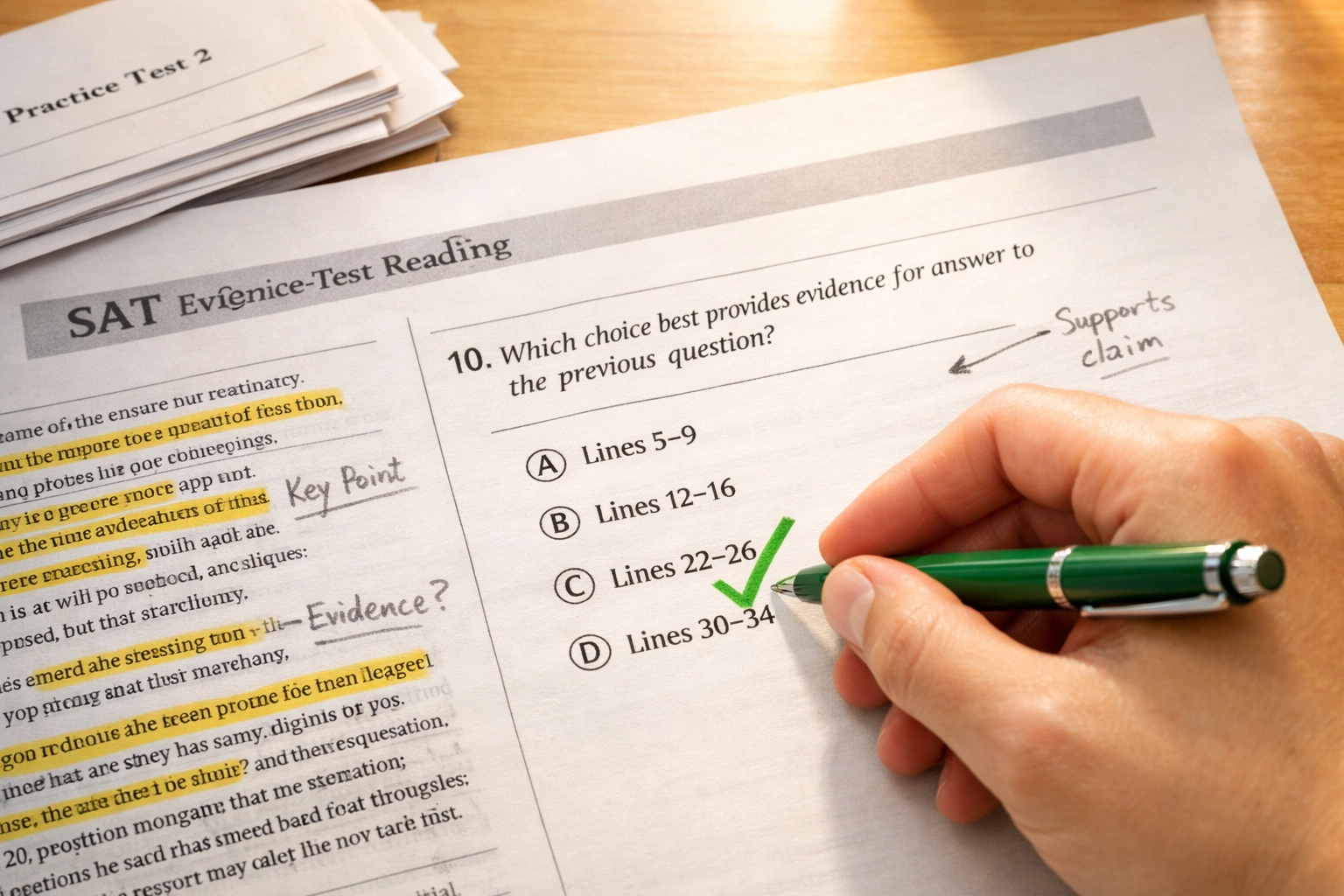
The Bottom Line: Evidence Is Everything
By now, you should see the pattern. SAT Reading isn't about being smart or making clever connections. It's about being disciplined. Every answer must be provable with specific words from the passage.
When you feel tempted to pick an answer that "sounds right," stop. Ask yourself: "Can I underline the exact sentence that proves this?" If the answer is no: or if you're making a logical leap: it's wrong.
The Reverse Method will save you time on paired questions. Start with the line citations. Match them to claims. Eliminate guesswork.
And remember the Golden Rule: If it's not in the text, it's wrong.
Master this mindset, and Command of Evidence questions will go from your nightmare to your guaranteed points. You've got this.
Ready to keep building your SAT mastery? Check out our other modules in the series, including Grammar Gold Standard: English Conventions and Mastering Circles and Angles. And if you want personalized guidance, book an appointment with one of our expert tutors.